Gidday Cynics,
Quitting is not my strong suit. It’s hard to think of something I’m worse at: apart from simultaneously quitting smoking, coffee and religion1 nearly twenty years ago, I don’t like to give up on things.
An incomplete list of all the things I haven’t quit includes:
- Working on a film
- Maybe a dozen short stories
- At least two much longer stories
- Several plays
- Martial arts
- The Gym
- A graphic novel and several short comics
- A webcomic
- Multiple YouTube channels for some reason
- Making art assets for a videogame
- Perhaps as many as… thirty paintings?
- Approximately ten thousand sketchbooks, which I stop drawing in as soon as I draw something I don’t like, which is often immediately
- A magazine
- Two businesses
- Learning how to program
- Maths, via Khan Academy, after it transpired that my inability at maths was making me a terrible programmer
- The guitar, in a general sense
- Several DIY projects
- My backyard, in a general sense
- Every herb or vege garden I’ve ever planted, in the specific sense that they have all either died or been destroyed by weeds that quickly become as large and intimidating as Triffids
- Any number of ultra-cringey “fix your life now!” online courses
- A second tertiary degree
- Umpteen feature stories. I’m sorry, editors.
- A built-to-fail parody NFT scheme, which I got obsessed with and consequently launched too late to take advantage of the NFT craze
- Volunteering for several different organisations, sometimes at the same time
- A truly alarming number of unfinished videogames
- An even more alarming number of self-help books, which (you may have noticed) often revolve around the concept of getting things done
- Two Substack newsletters, one of which you are reading right now
Some of those projects approached a degree of completion, some are underway, and some are still very much, uh, undone. But have I quit? Like hell. I’m still working on them all.
It’s just that most of the work is happening in my head.
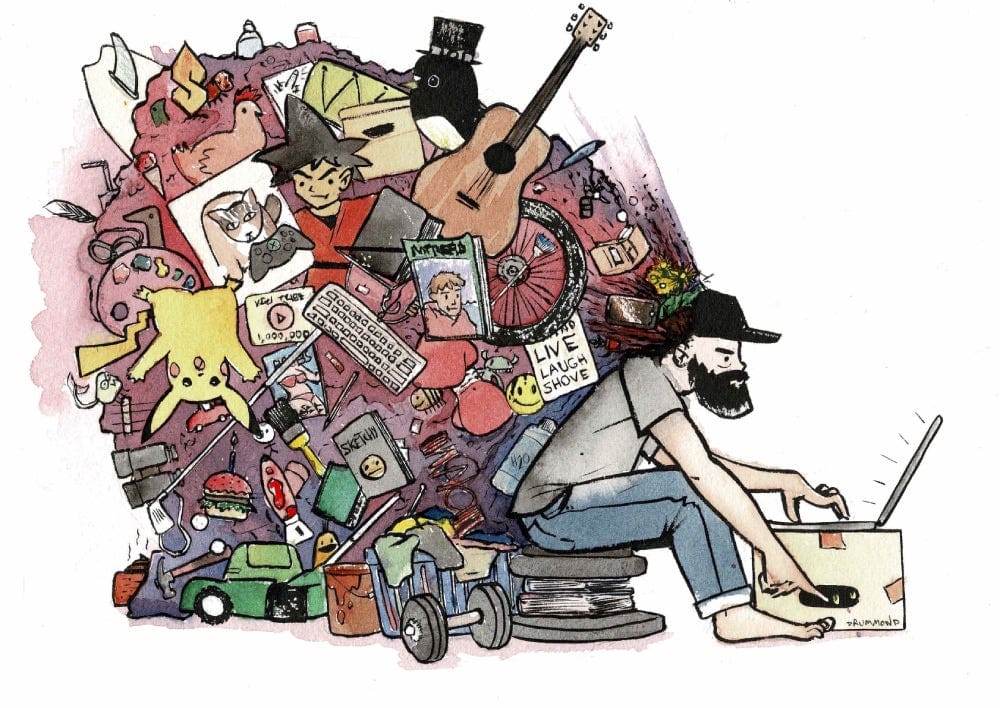
All this stuff has been getting free room and board in my mind since it moved in. Barely a day goes by where I don’t dwell on at least one and usually several of those projects, and some have been locked in “I’ll get back to that tomorrow, maybe” status since I was a teenager. Not one book idea, feature story pitch, comic book concept, song I wanted to learn, degree I wanted to do, YouTube video, or any other item on that ridiculous list ever gets forgotten about. Instead, they form an orderly line, waiting for their moment to appear in my mind’s eye and deliver a payload of guilt and shame. I often think that if I’d spent half as much time working on my ideas as I have worrying about them, they’d probably be finished by now. I once tried to draw what it feels like to carry all this baggage around in my head with its accompanying milieu of cultural detritus; ironically, I never finished the drawing, and it joined the endless queue.
I think about that drawing all the time.
Permanent over-commitment seems to have another side-effect: it’s ruined my ability to perceive success. Too often, achievements bring nothing but a sense of exhaustion. Instead of taking a break and a well-deserved pat on the back, all that seems possible is a joyless “yay;” another unsatisfying slog on an infinite mountain. The rate of progress on any given project halves with each additional project I add on. It’s Zeno’s Paradox, but for to-do lists.
What’s weirder is that, despite a lifetime of accumulated evidence, I always think I’ll have time for more shit. Apparently, in that annoying “everything is an ADHD trait” way, over-commitment, people-pleasing, and time blindness are all ADHD traits. I tried to find evidence of this in the academic literature and couldn’t quickly land anything conclusive, so I gave up.2
Happily, there is a self-help book to address this specific problem. Unhappily, it is terrible.
Beat over-commitment with this ONE weird Thing
The ONE Thing is a self-help book by real-estate kingpins Gary Keller and Jay Papasa3 which was a best-seller about a decade ago. I picked it up because the CEO of the company I was working for at the time recommended it. I won’t be joining his book club.
The premise of The ONE Thing is well grounded in reality: multitasking ain’t it. “Switching costs” — the cognitive cost of trying to do more than one cognitively demanding task at once — have been known about for a long time; the impossibility of multitasking effectively is the reason that it’s illegal to use your phone while you’re driving. But this might have taken a long time to filter into the business world, where multitasking was regularly praised as a sign of being a good corporate citizen. People used to put “multitasker” on their CVs!
What’s more, the book aims for every overworked office drone’s sweet spot: in all aspects, too much is being asked of us, and it’s making life impossible.
Harried and hurried, a nagging sense that we attempt too much and accomplish too little haunts our days. We sense intuitively that the path to more is through less, but the question is, Where to begin? From all that life has to offer, how do you choose? How do you make the best decisions possible, experience life at an extraordinary level, and never look back? Live the ONE Thing.
While there’s plenty to relate to there, I take the view that a lot of what’s wrong with is us not necessarily that we’re doing too many things but that we’re doing the wrong things — or, worse, that the right things are not permitted to us. I wrote about this for Webworm, in a piece that I’ll never stop linking to:

But, with all that said, some of us definitely have bitten off more than we can chew. While it might be part of a frantic, subconscious attempt to distract ourselves from the planetary mess we’re in, that doesn’t alter the fact that we’ve got too much on. Will the book help reduce that load? Let’s find out.
1. Distraction is natural. Don’t feel bad when you get distracted. Everyone gets distracted.
2. Multitasking takes a toll. At home or at work, distractions lead to poor choices, painful mistakes, and unnecessary stress.
3. Distraction undermines results. When you try to do too much at once, you can end up doing nothing well. Figure out what matters most in the moment and give it your undivided attention.
Right! How do I do that? Sadly, I may never know, because I was sick of the book by the time I was one-third through. The sinking feeling began with baffling diagrams:

Like so many self-help books, The ONE Thing quickly becomes an arduous slog through endless banalities, anecdotes, and home-cooked aphorisms like… whatever this is, from the chapter “Big is Bad.”
When we connect big with bad, we trigger shrinking thinking.
“Shrinking thinking” made me snort. It’s not evil, it’s just banal. But there’s plenty of evil to find! Like so many other self-help books in the “business advice” market, The ONE Thing ends up lionizing sociopathy, as in this glowing review of Walmart founder Sam Walton’s tax evasion:
Before Sam Walton opened the first Wal-Mart, he envisioned a business so big that he felt he needed to go ahead and set up his future estate to minimize inheritance taxes. By thinking big, long before he made it big, he was able to save his family an estimated $ 11 to $ 13 billion in estate taxes. Transferring the wealth of one of the greatest companies ever built as tax free as possible requires thinking big from the beginning.4
My Kindle note reads “What a piece of shit.” I didn’t go any further, not least because I figured I’d absorbed the book’s key message. Most self-help tomes could be reduced down to one chapter and not suffer. The ONE Thing is that rare self-help book where all the wisdom contained within could be condensed down to a single paragraph and be almost infinitely better for it. I will let this one-star Amazon review do the talking:
They were not kidding in the title when they said it was surprisingly simple. It was too simple, in that most people beyond the age of 20 have already figured out success is based on focusing on only a few things and not trying to do everything. That’s it, that is what the entire book is about. The author stretches this basic thought in to an entire book by including famous quotes and antidotal examples from other authors. This book at most should be the length of a brochure. I love good business and self-help authors, this is not one. I have never said this before, but do not waste your time reading this unoriginal and poorly written book.
I like “antidotal” examples. Also, I wonder if the review’s author and I are being needlessly ungenerous. The book’s premise of “concentrate on just ONE Thing™️” might be really, really, really obvious, but have I ever managed to do it? Almost never. So who am I to rag on the repetition? Maybe that’s what’s needed for the simple concept to sink in.
My ONE Thing(s)
(Don’t worry, I’ll be careful not to have too small a box lest I trigger shrinking thinking.)
After a nice round 40 years of over-commitment, it’s time to make a change. I’ve written about this concept before, usually circling around it a bit, because it’s genuinely difficult to think about, let alone write:
I quit.
If I’m to make any progress on anything I want to get done, I’m going to scrap a solid 95 percent of the things I want to get done, and embrace a concept that my brain very much does not like: my time is limited.
So yeah.
First, I’m going to take my undone to-do list and do this to it:

And here is what I’m going to do instead5:
1. Be good at my job
One of my worries with this newsletter is that it will do irrevocable damage to my job prospects. I can’t imagine someone reading this and thinking “hm, he seems a reliable sort, we’d best hire him.” For employment reasons I feel compelled to mention that I have been okay at past jobs. I’ve been promoted in every job I’ve had for the last decade, which seems a good sign. But I’m also acutely aware that my broad range of interests has probably got in the way of being as good as I could be. What’s more, I’m lucky: my current job is challenging and interesting, pays well enough to keep us housed and fed, and can be done remotely. In The ONE Thing’s janky parlance, it’s the “the One Thing I can do, such that by doing it, everything else will be easier or unnecessary.” I may as well be awesome at it.
2. Finish those goddamn paintings
I’ve got about five unfinished paintings that are either paid for, promised to someone, or in some other way overdue. Of course, the feeling of guilt over not getting them done (in addition to non-inconsequential life events) has snap-frozen any progress.
So, apart from my job and my husband-and-father commitments (which are so overwhelmingly and self-evidently important that they never end up on a to-do list) I won’t be working on any other optional tasks until the paintings are done. The lawn can mow itself. You, readers, can expect frequent, panicky painting updates.
3. Actually stick with the self-care routine
ONE Thing™️ that’s become obvious is that exercising regularly is non-optional for my brain health. I know this from what happens to me when I stop. Lately, I’ve been managing to get a daily exercise and meditation thing happening, in addition to regular gym-going, and it’s clearly worth prioritising.
4. ONE (Secret) Thing
Once those paintings are done I should have the mental space to launch a project I’ve wanted to do for years. If I tell you what it is I’ll jinx it, but if it works out I’ll never shut up about it.
5. Keep writing this newsletter
Ha! Did you read the clickbait headline and think you were finally free? I’m sorry, no. I’m doubling down on this newsletter. Writing it has been helpful for me, and hopefully for some of you too. But lately, it’s been pretty inconsistent — and having looked on with pride and envy at what friends who make things consistently have managed to accomplish, I want to make this newsletter reliably regular. I figure Mondays at 6 AM NZT is a good aspiration. In fact, if we doubled down on the solid little community we’ve got here it could be twice a week. What community stuff would you like to try out? Shared projects? Co-working/body doubling sessions? I’m keen to hear your ideas.
6. Everything else.
So is all that mental baggage gone forever? Of course not. It’s more that I’m trying to shunt it into storage rather than having it revolve endlessly on the conveyor belt of my mind. If I can get just ONE Thing™️ crossed off the list, then I can choose something else to get stuck into. If it works out, I’ll get more done, not less.
Oh, and in the spirit of finishing what I start, I did that drawing. Sure, it took me about 20 years, but I wasn’t about to quit.

-
I un-quit coffee a year or so ago, with the advent of parenting. I don’t see the others making a comeback though. ↩
-
That kind of impatience — perhaps we’d call it an attention deficit — is also probably also an ADHD trait. I dunno. There’s too many. I can’t keep up. ↩
-
And, I imagine, some extraordinarily long-suffering ghostwriters ↩
-
No, I don’t know how “Transferring the wealth of one of the greatest companies ever built as tax free as possible requires thinking big from the beginning” gets past an editor, either. ↩
-
The ONE Thing also makes the case that having just ONE Thing is impossible and in fact you must have multiple ONE Things, which — I hate to be pedantic — is more than ONE Thing. This is explained about three quarters of the way through the book. Fortunately, I found this out from reading reviews, instead of the book itself ↩