Tag: writing

  • Embodying embodiment

    Embodying embodiment

    Last year, when I drew a bit of a line under my self-improvement experiment by writing up the results for The Spinoff, I expanded on a growing hunch that the main issue with self-improvement originates in the medium; books simply aren’t a good way to learn things that involve your body. Here’s what I said at the time.

    Whether you’re learning an instrument or forming atomic habits, you’ll do better if you’re doing it with others, while taking deliberate, somatic action that’s much more than turning pages or imbibing inspirational TikToks.

    The idea of somatic self-improvement has continued to interest me, and it all came to a head (this is a pun, you will realise how clever it is shortly) when I was trying to do a digital map for the online tabletop role-playing game I DM for a few mates and found myself drawing – literally – a blank. I tried several different computer-based tools, all of which promised to help DMs make dungeons in mere minutes. Nothing helped, and I found myself in a weird paralysis panic. It wasn’t that I didn’t know how to use the tools, although there was a learning curve; it was more like my brain and what I was attempting to make felt fundamentally disconnected. The ideas I had simply weren’t translating into the digital medium, and this felt quite scary, to be honest, as someone who makes digital things for a living.

    Then I grabbed a sheet of paper and a pencil and drew the dungeon map I’d been failing to make for several hours using digital tools. It took about ten minutes.

    And then – having found a starting point, able to envision and render my ideas – I could finally make progress using the digital tools.

    What might have been going on here? I mean, apart from the obvious: that I am kind of an idiot. Anyone who has ever done anything design-wise or who draws things knows it’s helpful to sketch out an idea first, and it’s odd that I didn’t think of doing that. But I do want to explore the why a little bit, because sometimes understanding the why helps us get on with the how.

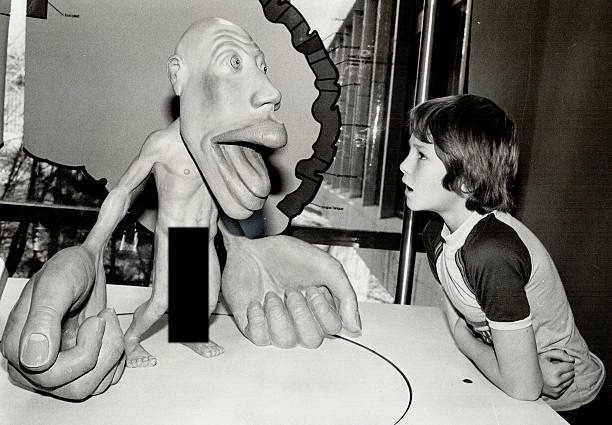
    It’s time to return to our old buddy, the Sensory Homunculus. “Return to,” here is just a figure of speech; I’m not sure I’ve specifically mentioned our little friend here before. You’d probably remember him, because he looks like this:

    Kill it! Kill it!

    What is that… abomination? The sensory homunculus (and its close relation, the cortical homunculus) is a representation of the space our brains use to run different bits of our body via the nerves1. As I’m sure you’ve noted, the hands are bigger than the rest of the body combined. The right hand alone (the sculpture is of someone who is right-hand dominant) is the same size as nearly everything else in the body. When people compliment you by saying “You’ve got a lot of nerve!” they are talking about your hands specifically.

    I’m interested in this little dude not just because I find it entertainingly horrific but because the implications are fascinating. The priority that our brains assign to our hands, and by extension, the things we do with our hands, may be incredibly helpful in explaining a great number of things, some of of which are my perpetual bugbears: why self-improvement can so hard to put into action, why it’s so easy to get distracted on a digital device, why we fidget, why fidgeting can improve concentration, and why we can’t put down our bloody phones.

    As in, the phone you’re probably reading this article on.

    There is a field of philosophy that intersects with neuroscience called “embodied cognition.” The idea is the mind-body duality is a lie; they’re actually all one piece. Physiologically this amounts to less a theory and more a hard truth, one that’s easily observed if you sever the spinal cord, or cut off a limb. Your brain, body, nerves, muscles; everything is intertwined. Embodied cognition argues less that cognition requires a body, and more that cognition is a body, and that it’s rather silly to speak of cognition without it. I like this theory, not least because it’s another nail in the “OMG AI is going to become sentient any financial year now” coffin.2 And to me it’s another reason why relying on AI can be so dangerous, as doing so delivers the cognitive impact of playing rugby against a brick wall.

    I shouldn’t spend too long on this, although God knows I’d love to; here is the Wikipedia page on embodied cognition if you’d like to do some further reading. My point is this: your hands aren’t just connected to your brain. Your hands are your brain. Kind of! With some obvious and quite important caveats! Like if you lose your hands you can live, but if you get Marie Antoinetted you can’t.

    Put it this way: If you’re using your hands, you’re using some big chunks of your brain. And those chunks are connecting to other chunks, and it’s possible that all these brain bits3, working together, mean you might have an easier time doing what you’re doing, or continuing doing whatever you’re doing.

    I think this may be why I had such an easy time sketching my dungeon diagram compared to when I was trying to lay it out via computer software. There’s one less abstraction layer; doing it in a tactile way just made more sense to my body. I also think it’s part of what keeps us so tethered to our phones in particular. Apple’s greatest triumph – soon shared by the rest of the tech world – was creating technology that you caress to make it work.4 The brain-space devoted to Hand Stuff combines with all the tricks learned by the unholy combination of television, psychology, social connection, videogames, and gambling to create a device that’s almost literally unputdownable.

    Because our lives are governed by malicious deities of irony, a fact I’ve long respected, you won’t be surprised to learn that while I was mulling all this over I scrolled across a video essay saying almost exactly the same thing only more coherently, which I’ve posted below.

    Given what seemed to be accumulating signs that I should, I have returned to writing. As in, handwriting.

    No, I didn’t write this article by hand. (It’s too hard to embed the YouTube videos.) But I have made a point of handwriting notes again, and after struggling with a manuscript for a long-stalled fiction project, I’ve started writing it by hand too.

    There are a few reasons for this. One is that the positive association between handwriting and memory is very well established. There’s no need for one of my pet theories here; there are plenty of real ones to choose from. Don’t take my word for it, here’s Scientific American’s:

    Sophia Vinci-Booher says [the] findings are exciting and consistent with past research. “You can see that in tasks that really lock the motor and sensory systems together, such as in handwriting, there’s this really clear tie between this motor action being accomplished and the visual and conceptual recognition being created,” she says. “As you’re drawing a letter or writing a word, you’re taking this perceptual understanding of something and using your motor system to create it.” That creation is then fed back into the visual system, where it’s processed again—strengthening the connection between an action and the images or words associated with it. It’s similar to imagining something and then creating it: when you materialize something from your imagination (by writing it, drawing it or building it), this reinforces the imagined concept and helps it stick in your memory.

    I’ve talked before about how alarming I find the memory loss arising from parenting-related sleep deprivation, and this might be one way to stave it off. Also, I wasn’t happy with my handwriting. Over years of prioritising typing, my writing had degraded to a kind of sine wave with an occasional spike, like the reading on the heart monitor of someone who is about to die tragically in a hospital show. So I’m writing the first draft of my book and all my notes in cursive, which I never learned properly, so I can finally like how my handwriting looks.

    This sort of thing has worked well for me in the past. About halfway through my second year of university I taught myself to touch-type while pulling an all-nighter because I wanted to spend the following day snowboarding.5 It was very slow at first but by the morning I was having some quite interesting auditory hallucinations and I could touch-type. I’m not doing any all-nighters this time but I’m already finding an enormous improvement in my cursive after only a few days.

    There are other benefits as well. This morning I put thirty minutes aside for manuscript writing/cursive practice, and I found something interesting: the writer’s block6 I’d had for a long time on this specific project completely went away. Why? Because instead of agonising over the prose and editing as I went, I was instead agonising over the shapes of the letters. The writing just kind of wrote itself; it was the least I’ve self-edited in years. I timed myself and to my surprise, I found that after thirty minutes I’d written more than four hundred words.7

    Oh, and I didn’t look at my phone the entire time I was writing. I didn’t even feel tempted to. Given that smartphones give me itchier fingers than smoking ever did, this is a real achievement. Like so much else, this is obvious in hindsight. Of course it’s hard to write on the Infinite Distraction Machine! What else did I expect?

    On that note, here is another video that clicked with me for… reasons.

    Whether you watched that weird little video or not, do start a creative project. Acquire a hand loom and become a neo-Luddite. Do an upsetting drawing of a cat. Join the Butlerian Jihad. Write the furry fanfic you’ve always wanted to write.

    Just make sure you use your hands to do it.

    Then use your computer or phone to leave a comment and tell me all about it.


    Like & Subscribe

    If you want to support my work, please consider a paid subscription. (Once you are done considering, please take out a paid subscription.)

    Subscribe for $5 a month, or subscribe for $50 a year.

    I’ll let you do the maths on which is better.


    1. It’s not a perfect representation, of course – the homunculus is for illustrative purposes only. As the article says: “The amount of cortex devoted to any given body region is not proportional to that body region’s surface area or volume, but rather to how richly innervated that region is.” And I understand several of those words, which means I’m obviously qualified to be writing this article. ↩︎
    2. At this stage stage you could convincingly argue that it’s more nails than coffin. ↩︎
    3. Sorry for all the neuroscience terms like “brain bits.” I can’t help my enormous vocabulary. Also, all the mistakes in this article are there on purpose to upset all the neuroscientists that I’m close friends with. ↩︎
    4. Starting with the venerable iPod. ↩︎
    5. See also footnotes in previous articles about the autism being more obvious in hindsight. ↩︎
    6. This is just a pretentious way of saying I get anxious and procrastinate a lot about writing specifically. ↩︎
    7. Which I had to count myself, with my brain, like a commoner. ↩︎

  • Go warm turkey on screen-time

    Go warm turkey on screen-time

    It’s Thanksgiving, or near enough to it, and that’s enough of a segue to another article about the benefits of cold-turkeying your phone screentime. And I owe you an update on how I’m doing since last week’s effort. Here it is.

    Screenshot

    And while 1.5 hours a day (where it’s sat since) is a huge improvement, and I’m pleased that a lot of that screentime was substituted with being present with my kids or doing actual work, it is still too damn high. So I continue on my scrolling-reduction buzz; I hope you’re all cool with that. Luckily it seems like the one bad habit we all share.

    During one of my occasional trips to Reddit I felt seen by a post in r/millennials, a nostalgia subreddit that is becoming upsettingly relevant:

    I have a full time job. I sleep well. I have no kids. I’m single. I don’t party or drink. I’m not particularly stressed in day to day life. Yet I’m fucking exhausted. I don’t want to leave my apartment on the weekends unless I have something planned, and even then I’m pretty picky. In my 20s my weekends were full of non-stop activities, cooking, going out, and posting on social media. But now in my 30s I just want to come home, have my groceries delivered, chill with some Netflix and sleep. Please tell me I’m not the only one!!

    Of course, the entire concept of a DAE (Does Anyone Else) bait post is that nearly everyone is indeed experiencing what you are; and with the millennial cohort now either in or rapidly approaching their 40s it’s really no surprise that folks feel tired. But I do think there’s something else besides aging going on, and a short scroll revealed that others do too.

    “It’s not just the work culture,” opines DarkLordFrondo, “it’s the entire culture. It is unending overstimulation and high anxiety with decisions repeatedly made for the sake of convenience instead of quality. It permeates into everything, so we still feel like we are at work even when we come home.”

    “Well said!” agrees DowntownResident993. “Constant overstimulation and the need to appear or BE busy, even if that is just putting our head down into our phone. Access to everyone and everything at any given notice makes people carry their work everywhere they go.”

    “It’s not just working, it’s our diets and constant media consumption especially short form,” adds KD_42.

    And they’re right. We are tired all the time, over and above all the things that would normally make us tired (parenting, hangovers.) It’s not just normal tired, like you get after physical labour; it’s an inherently disjointed brain-tired body-not experience. You should have more energy, but you don’t.

    And at the risk of succumbing to monocausotaxophilia, it’s the phones. Or rather, it’s the screens, but the phones are the worst offenders, because they’re everywhere you are and they’re constantly calling your name.

    As always Casey Johnstone has the goods, in this excellent article about how to read more. Kill your phone, she says.

    The best way for me to read more is to choose to do it instead of something else already do, something I can stop doing. This is less and less controversial to say every day, but your phone is not your friend. It is specifically, categorically your enemy in almost every way, and especially when it comes to reading.

    I don’t know about you, but basically all the time I spend on my phone is time I could be reading a book instead. Sometimes, that was four hours a day. That’s bonkers. I nuked my phone a couple of years ago and quit social media this year and these were amazing decisions for someone with my particular set of mental challenges. I imagine there are people who have a sustained relationship with social media who read books. I am not one of them, especially now that social media is such a cesspool of stuff I never asked to see. If you are able to open Instagram, close it five minutes later, put your phone down, go into another room, and then read a book for an hour with total focus, I’m in awe of you.

    I think the most important and broadly scientific insight I can provide about scrolling is that it takes up about the same amount of mental bandwidth, or fuel (to use last week’s metaphor) that actually doing something you want to do would use. Or to put it in meme format: 1 scroll = 1 fuel.

    But 1 fuel = 1 thing you actually wanted to do.

    If scrolling really has hijacked your urge to create, the adverse is true: for the mental effort expended on scrolling you could be doing something you want to be doing. They take about the same amount of mental energy – the difference is that scrolling is easier to fall into.

    I think it all adds up to a good argument for putting the phone down.

    But what if you can’t?

    If you are unavoidably welded to your phone — first, side-eye. Is it really unavoidable?

    But at some times, for some people, it is genuinely difficult to do anything else. If you are a new mum in the modern world, your phone is your umbilical cord to the rest of it. And if you’re sick, why would you decide to put down a device that can keep you in touch with your friends and watch shows on without needing to hobble to the TV while sneezing?

    If cold turkey is not an option, what about warm turkey?

    Why not use the screentime to do something you want to be doing?

    Why not write the great American a novel?

    I’m serious.

    Phones are a bit annoying to type on but that doesn’t stop us when we need to text a friend, or spend many hours texting many friends. And one good things AI has going for it is that voice recognition is getting a lot better.

    Apps? Google Docs is free. The notes app on your phone is free. Novelist is free. Obsidian is free. iA Writer is paid (but very beautiful.) There are umpteen more writing-on-your-phone apps.

    If you think it sounds ridiculous, I have news for you: author Emily Writes (who I work with now!) wrote two books on her phone.

    While wrangling a kid or two.

    If you’re using it to enable creativity on that scale, screentime goes from “cause of hives” to “badge of honour”

    Even if you’re not a perpetually thwarted author there’s always reading on your phone. Kobo, Kindle, whatever your OS’s native book reader is.

    If you can’t not be on your phone, it beats scrolling.

    Lifehack: muttering to yourself

    A lot of my personal productivity problems come from not being able to decide what to do next, and it turns out I have a lifehack for that: I talk to myself. Like a nutcase.

    If I’m stuck in a task or have suddenly arrived in the kitchen without knowing why, I’ll say “What are you doing?” to myself — ideally not in an annoyed way — and I find that if I actually take time to talk myself through what I’d like to be doing the thing starts getting done.

    I thought this was just being weird and therefore not worthy of mentioning but apparently it helps with executive function, which is something those of us blessed with ADHD struggle with. Don’t take my word for it, take psychology’s:

    And there’s the slightly less authoritative but still useful word of Reddit:

    Talking to yourself is also good to prevent you falling into or staying a scroll-hole; if you’ve just picked up your phone aimlessly (again!) just ask yourself “What am I doing?” or “What do I want to be doing?” and that can help steer you into either putting it down or cracking on with Chapter 34: The Clonosaurus Rises.

    Thanks, as always, for reading.

    Here’s how to support this newsletter!

    Subscribe to free posts:

    Become a Premium Newsletter Subscriber using the Big Blue Button below and get paid-only updates in your email + access to high-res digital downloads of all my artwork + other cool stuff!

    Give a koha/one off donation using the below form.

  • Day 22: the points

    Day 22: the points

    • today’s email is all bullet points
    • I looked up just now and it’s 11:07
    • I got stuck writing that AI article, I really want to get it finished and published before the AI bubble pops
    • but before I sat down and got stuck into that nightmare topic I put all the horrible intrusive devices down and mostly forgot about the pressing need to build my business for a bit and
    • mowed the lawns
    • cleaned the kitchen
    • picked up a twokidsworth of mess
    • vacuumed the house
    • watered the plants
    • and a few other miscellaneous tasks
    • needless to say, the kids were at the grandparent’s place while this frenzy of activity occurred
    • then played with the kids once they got home, you do miss the little things when they’re away
    • my daughter has learned the East Coast wave and thinks that when she does it it’s the funniest thing in the world (she is correct) but nothing makes her laugh as much as when her big brother joins her on the floor and crawls and chases her about
    • and once the kids were home we ate fish and chips as a family at the outdoor table on the deck as the shadows grew long and the sky turned into that fantastic orange-pink-purple gradient
    • and it all crashes in on me as I write this, how wonderful this is, how blessed we are; what did I ever do to deserve this family, this heaven
    • thank you, as always, for reading

  • Day 21: aaaaarghhhhh

    Day 21: aaaaarghhhhh

    I nearly made the whole body of the email just “aaaargh” but I opted for not. But man, it was tempting. I just spent the best part of the evening taking turns with My Wife trying to get the daughter to sleep when she would much rather be up making cute and not-so-cute noises and yeah. Aaaargh.

    I also started doing my morning todo list with my morning coffee — apparently when you’re trying to make a new habit, it’s best to tie the new one to something you do without fail, and I simply never don’t drink coffee. Tonight, after getting through about half of the todo list as is traditional, I am starting to think that the list is simply too long. I’ve read before that it’s better to keep a shorter todo list and get everything checked off than have a long one you can’t complete. But then where will I put the things I need to remember to do but can’t do today? And having all those undone ones looks so untidy; and writing out the same task again the following day is just a pain.

    I have never once found a todo system that works for me. Bullet journaling is the closest thing to it but I find myself getting annoyed with that too. Every app has been a mixture of too much and too little, not to mention extortionate pricing. Hey, maybe this nifty little thing that got profiled in the New York Times might help…

    https://www.nytimes.com/wirecutter/reviews/ugmonk-analog-to-do-system-review

    Wait, what? It’s $100? For a piece of wood with a slot in it? No. God no. This self-improvement space is so endlessly rife with these things; if it’s not an outright grift it’s just absurdly expensive. Maybe I’ll just make one myself; I’ll need some cardstock for the printer and some plywood. If you have access to tools want one I suggest going the same route; by the time you’re done you’ll have an organiser, saved yourself around $90, and you’ll have learned some woodworking!

    Or you could just keep the cards on your desk. In a rubber band. They’re like ten cents. Also, I reread the article to check something just now and realised it contains the phrase “The Analog system speaks to my Gemini spirit,” which made me want to bite down on broken glass. Even more aaaargh.


    The things that got done today include getting the first batch of Print Club prints sent off (there is still space to join Print Club this October if anyone wants to get amongst it!) as well as the commission I finished yesterday. For reasons I don’t entirely understand, doing this took up nearly the entire morning. Seemingly simple things that develop unwieldy complications as you go are my least favourite kind of tasks. Anyway, here’s the Print Club, in case you missed it the first time around.

    Do check it out; I am often very wrong about what I want to be popular but I can’t help loving the idea of getting snail mail happening again.


    miscellaneous

    A reader sent me this video which I’ve seen before but will watch again, which resonates with the magical combination of “inspirational” and “uncomfortably seen.”

    So. How was your week? Feel free to ping me a reply. I appreciate you sticking around for this series, especially on a night like tonight when I imagine these even more frustrating to read than they are to write.

    Still, I’m here, and it’s Day 21, and I haven’t missed a day yet. Even if all I manage to send is a mass of guff, I’m finally putting together the daily writing habit I’ve always wanted to have, and once this challenge is over I think it’ll serve me well.

    Thanks, as always, for reading.

  • Day 8: Sawing the Zs

    Day 8: Sawing the Zs

    Sawing the Z’s

    Every day I teeter on the edge of not sending one of these out; every day (or night) I manage to do it anyway.

    A lot of the pain I experience, mental or physical, has to do with overthinking. I overthink my art, my work, my videos, my newsletters, my health, my relationships; and while I’m sure this is a human universal — no special snowflake stuff here, we’re a species of overthinkers or we’d probably have stayed happy in the trees — I find I could often do with a bit less of it. That’s what this do-shit-everyday project has accomplished, for this newsletter and much else, and for that alone it has been worth it. Instead of agonising over a given decision the short time-frames involved mean I just get stuck in and do the thing. Finally. At last. Took me long enough.

    The side effect is that I am very tired and spent this morning sleeping in. Don’t worry, it’s not all the newsletter. A lot of it’s my infant child’s emerging teeth causing her to yell in pain throughout the night as nature apparently intended. But I am pooped, almost as much as she is, and I need to turn in early tonight.

    I’m still on the wagon. I went for a run today. I did pullups. And I noticed that after struggling to make 5 pullups at the start of this thirty day thing I am now quietly putting away a couple more per set. I spent a bit of quality time fiddling with my Dungeons & Dragons character sheet; that warlock/bard gunslinger multiclass in a alt-history Wild West setting isn’t going to roll itself, is it?

    Oh and a bunch of folks on TikTok really liked that stamp video, and several people actually subscribed to my print club! Exciting stuff (here it is again, if you want to use it to write actual letters to your actual friends.)

    I also made a much-requested shirt:

    Also I just realised that it’s been more than a week since I did the proper Cynic’s Guide email to all subscribers. Irony! You guys have had more emails than I’ve sent in the rest of the year, and I still haven’t quite managed a weekly cadence for the rest of the email list. Tomorrow! It’ll give them something fun to do with their Sunday.

    After this email goes out I’ll head to bed. I can’t wait to sleep blissfully for thirty minutes before the baby wakes up.

    Thanks for sticking with me as I stick to whatever this is.

    A skeptical dive into the weird, sketchy, occasionally life-changing world
    of self-improvement.

    Social hellsites:

    The Gram:
    https://www.instagram.com/tworuru/

    The Tube:
    https://www.youtube.com/tworuru

    The Tok:
    https://www.tiktok.com/@tworuru

    And of course, my website, where art can be bought and all these newsletters are archived (and can even be commented on!) is

  • The Department of Biological Determinism

    The Department of Biological Determinism

    This is a short story set in the world of Harry Potter. Any questions sparked by that sentence, like “why?” and “no, seriously, after everything JKR has said and done… why? are, I’m afraid, best answered by reading the the fanfic. I know that the words “fanfic” and “Harry Potter” are enough to create a near-impenetrable resistance to clicking links or reading further, but seriously, if you like any of my work, just read:

    The Department of Biological Determinism

    (The story is hosted at Archive Of Our Own for not-getting-sued-into-oblivion reasons.)

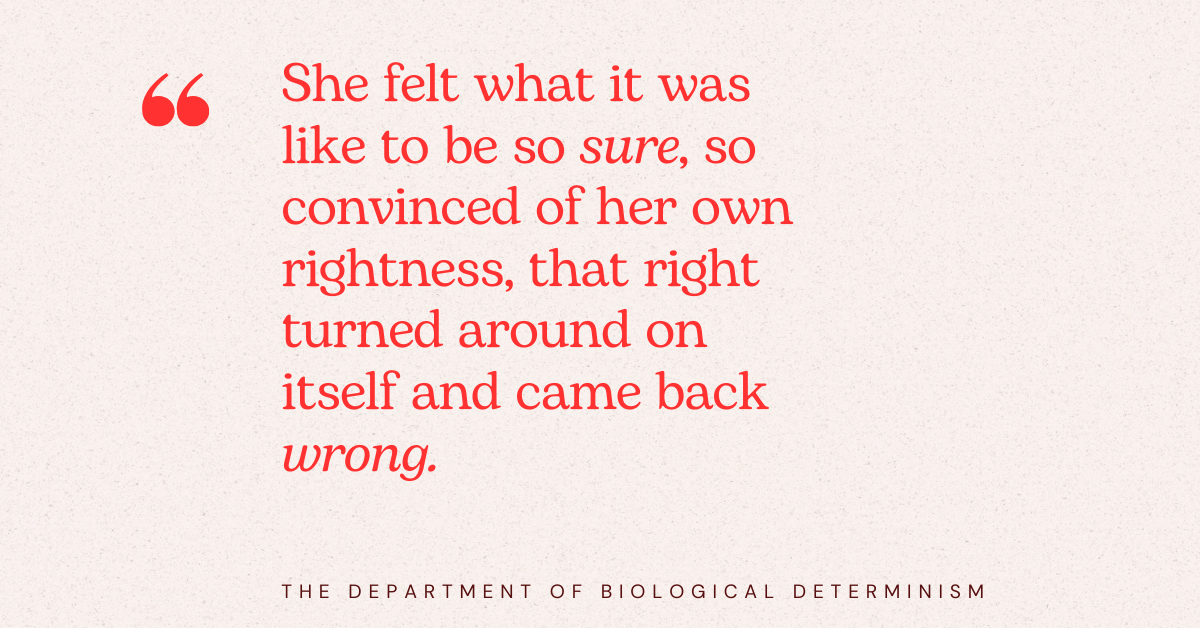
    A quote from 'The Department of Biological Determinism' that says "She felt what it was like to be so sure, so convinced of her own rightness, that right turned around on itself and came back wrong"
  • Malice through the looking-glass

    Back in 2014 – right around the time I was getting married – I did some research and interview work for the project that eventually became the documentary Tickled. Which is why I have this URL, in fact. Anyway, Tickled has been having an interesting time of it. As well as rave reviews they’ve been getting all kinds of attention, including having the subjects of their film show up at an LA Q&A session. I wrote a piece for The Spinoff about it, and you can read it here.