
Last year, when I drew a bit of a line under my self-improvement experiment by writing up the results for The Spinoff, I expanded on a growing hunch that the main issue with self-improvement originates in the medium; books simply aren’t a good way to learn things that involve your body. Here’s what I said at the time.
Whether you’re learning an instrument or forming atomic habits, you’ll do better if you’re doing it with others, while taking deliberate, somatic action that’s much more than turning pages or imbibing inspirational TikToks.
The idea of somatic self-improvement has continued to interest me, and it all came to a head (this is a pun, you will realise how clever it is shortly) when I was trying to do a digital map for the online tabletop role-playing game I DM for a few mates and found myself drawing – literally – a blank. I tried several different computer-based tools, all of which promised to help DMs make dungeons in mere minutes. Nothing helped, and I found myself in a weird paralysis panic. It wasn’t that I didn’t know how to use the tools, although there was a learning curve; it was more like my brain and what I was attempting to make felt fundamentally disconnected. The ideas I had simply weren’t translating into the digital medium, and this felt quite scary, to be honest, as someone who makes digital things for a living.
Then I grabbed a sheet of paper and a pencil and drew the dungeon map I’d been failing to make for several hours using digital tools. It took about ten minutes.
And then – having found a starting point, able to envision and render my ideas – I could finally make progress using the digital tools.
What might have been going on here? I mean, apart from the obvious: that I am kind of an idiot. Anyone who has ever done anything design-wise or who draws things knows it’s helpful to sketch out an idea first, and it’s odd that I didn’t think of doing that. But I do want to explore the why a little bit, because sometimes understanding the why helps us get on with the how.
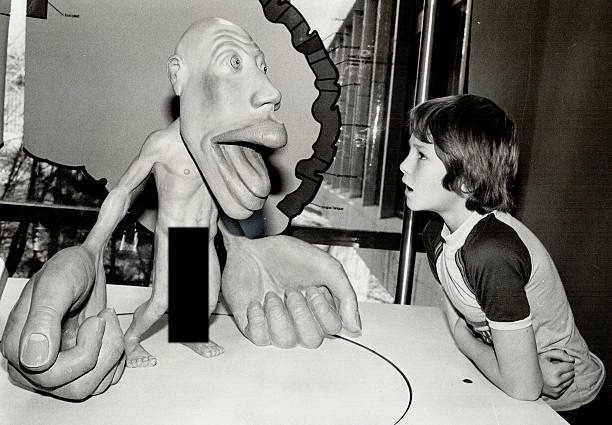
It’s time to return to our old buddy, the Sensory Homunculus. “Return to,” here is just a figure of speech; I’m not sure I’ve specifically mentioned our little friend here before. You’d probably remember him, because he looks like this:

What is that… abomination? The sensory homunculus (and its close relation, the cortical homunculus) is a representation of the space our brains use to run different bits of our body via the nerves1. As I’m sure you’ve noted, the hands are bigger than the rest of the body combined. The right hand alone (the sculpture is of someone who is right-hand dominant) is the same size as nearly everything else in the body. When people compliment you by saying “You’ve got a lot of nerve!” they are talking about your hands specifically.
I’m interested in this little dude not just because I find it entertainingly horrific but because the implications are fascinating. The priority that our brains assign to our hands, and by extension, the things we do with our hands, may be incredibly helpful in explaining a great number of things, some of of which are my perpetual bugbears: why self-improvement can so hard to put into action, why it’s so easy to get distracted on a digital device, why we fidget, why fidgeting can improve concentration, and why we can’t put down our bloody phones.
As in, the phone you’re probably reading this article on.
There is a field of philosophy that intersects with neuroscience called “embodied cognition.” The idea is the mind-body duality is a lie; they’re actually all one piece. Physiologically this amounts to less a theory and more a hard truth, one that’s easily observed if you sever the spinal cord, or cut off a limb. Your brain, body, nerves, muscles; everything is intertwined. Embodied cognition argues less that cognition requires a body, and more that cognition is a body, and that it’s rather silly to speak of cognition without it. I like this theory, not least because it’s another nail in the “OMG AI is going to become sentient any financial year now” coffin.2 And to me it’s another reason why relying on AI can be so dangerous, as doing so delivers the cognitive impact of playing rugby against a brick wall.
I shouldn’t spend too long on this, although God knows I’d love to; here is the Wikipedia page on embodied cognition if you’d like to do some further reading. My point is this: your hands aren’t just connected to your brain. Your hands are your brain. Kind of! With some obvious and quite important caveats! Like if you lose your hands you can live, but if you get Marie Antoinetted you can’t.
Put it this way: If you’re using your hands, you’re using some big chunks of your brain. And those chunks are connecting to other chunks, and it’s possible that all these brain bits3, working together, mean you might have an easier time doing what you’re doing, or continuing doing whatever you’re doing.
I think this may be why I had such an easy time sketching my dungeon diagram compared to when I was trying to lay it out via computer software. There’s one less abstraction layer; doing it in a tactile way just made more sense to my body. I also think it’s part of what keeps us so tethered to our phones in particular. Apple’s greatest triumph – soon shared by the rest of the tech world – was creating technology that you caress to make it work.4 The brain-space devoted to Hand Stuff combines with all the tricks learned by the unholy combination of television, psychology, social connection, videogames, and gambling to create a device that’s almost literally unputdownable.
Because our lives are governed by malicious deities of irony, a fact I’ve long respected, you won’t be surprised to learn that while I was mulling all this over I scrolled across a video essay saying almost exactly the same thing only more coherently, which I’ve posted below.
Given what seemed to be accumulating signs that I should, I have returned to writing. As in, handwriting.
No, I didn’t write this article by hand. (It’s too hard to embed the YouTube videos.) But I have made a point of handwriting notes again, and after struggling with a manuscript for a long-stalled fiction project, I’ve started writing it by hand too.
There are a few reasons for this. One is that the positive association between handwriting and memory is very well established. There’s no need for one of my pet theories here; there are plenty of real ones to choose from. Don’t take my word for it, here’s Scientific American’s:
Sophia Vinci-Booher says [the] findings are exciting and consistent with past research. “You can see that in tasks that really lock the motor and sensory systems together, such as in handwriting, there’s this really clear tie between this motor action being accomplished and the visual and conceptual recognition being created,” she says. “As you’re drawing a letter or writing a word, you’re taking this perceptual understanding of something and using your motor system to create it.” That creation is then fed back into the visual system, where it’s processed again—strengthening the connection between an action and the images or words associated with it. It’s similar to imagining something and then creating it: when you materialize something from your imagination (by writing it, drawing it or building it), this reinforces the imagined concept and helps it stick in your memory.
I’ve talked before about how alarming I find the memory loss arising from parenting-related sleep deprivation, and this might be one way to stave it off. Also, I wasn’t happy with my handwriting. Over years of prioritising typing, my writing had degraded to a kind of sine wave with an occasional spike, like the reading on the heart monitor of someone who is about to die tragically in a hospital show. So I’m writing the first draft of my book and all my notes in cursive, which I never learned properly, so I can finally like how my handwriting looks.
This sort of thing has worked well for me in the past. About halfway through my second year of university I taught myself to touch-type while pulling an all-nighter because I wanted to spend the following day snowboarding.5 It was very slow at first but by the morning I was having some quite interesting auditory hallucinations and I could touch-type. I’m not doing any all-nighters this time but I’m already finding an enormous improvement in my cursive after only a few days.
There are other benefits as well. This morning I put thirty minutes aside for manuscript writing/cursive practice, and I found something interesting: the writer’s block6 I’d had for a long time on this specific project completely went away. Why? Because instead of agonising over the prose and editing as I went, I was instead agonising over the shapes of the letters. The writing just kind of wrote itself; it was the least I’ve self-edited in years. I timed myself and to my surprise, I found that after thirty minutes I’d written more than four hundred words.7
Oh, and I didn’t look at my phone the entire time I was writing. I didn’t even feel tempted to. Given that smartphones give me itchier fingers than smoking ever did, this is a real achievement. Like so much else, this is obvious in hindsight. Of course it’s hard to write on the Infinite Distraction Machine! What else did I expect?
On that note, here is another video that clicked with me for… reasons.
Whether you watched that weird little video or not, do start a creative project. Acquire a hand loom and become a neo-Luddite. Do an upsetting drawing of a cat. Join the Butlerian Jihad. Write the furry fanfic you’ve always wanted to write.
Just make sure you use your hands to do it.
Then use your computer or phone to leave a comment and tell me all about it.
Like & Subscribe
If you want to support my work, please consider a paid subscription. (Once you are done considering, please take out a paid subscription.)
Subscribe for $5 a month, or subscribe for $50 a year.
I’ll let you do the maths on which is better.
- It’s not a perfect representation, of course – the homunculus is for illustrative purposes only. As the article says: “The amount of cortex devoted to any given body region is not proportional to that body region’s surface area or volume, but rather to how richly innervated that region is.” And I understand several of those words, which means I’m obviously qualified to be writing this article. ↩︎
- At this stage stage you could convincingly argue that it’s more nails than coffin. ↩︎
- Sorry for all the neuroscience terms like “brain bits.” I can’t help my enormous vocabulary. Also, all the mistakes in this article are there on purpose to upset all the neuroscientists that I’m close friends with. ↩︎
- Starting with the venerable iPod. ↩︎
- See also footnotes in previous articles about the autism being more obvious in hindsight. ↩︎
- This is just a pretentious way of saying I get anxious and procrastinate a lot about writing specifically. ↩︎
- Which I had to count myself, with my brain, like a commoner. ↩︎