Author: tworuru

  • All the Garbage I Found On Substack In One Hour: An Update

    All the Garbage I Found On Substack In One Hour: An Update

    Content warning

    This post contains examples of rampant anti-Semitic hate speech, Nazism, white supremacy, some of the worst and weirdest anti-science/anti-vax stuff I’ve seen anywhere on the Internet, anti-trans hate speech, and Glinner. Read at your own risk. Have a shower ready.


    It started with a story recommended by Substack itself. Through a bit of judicious user tracking and algorithmic filtering, Substack have divined that I’m interested in “Climate & Environment.” They’re right. In their app and web interface, Substack recommend the top five newsletters in this category. One day a few weeks ago, the number two slot caught my eye. It was plugging a “Dr. Simon,” and I found it interesting because the headline seemed to suggest that the Doctor wasn’t writing conventional climate news. In fact, it seemed to be at right-angles to observable reality.

    The headline was “Are We Losing the War for Freedom to the Great Reset?”

    The “Great Reset” is a conspiracy theory which can trace roots, as so many conspiracy theories can, to the antisemitic “Protocols of the Learned Elders of Zion” hoax. It is a relation of the Great Replacement conspiracy that has inspired many acts of terrorism, including the Christchurch mosque massacre. The BBC puts it bluntly:

    A vague set of proposals from an influential organisation has been transformed by online conspiracy theorists into a powerful viral rallying cry. What is the truth behind the “Great Reset”?

    Believers spin dark tales about an authoritarian socialist world government run by powerful capitalists and politicians – a secret cabal that is broadcasting its plan around the world.

    I was surprised to see Great Reset content recommended in the “Climate and Environment” category, so I clicked through.

    It was worse than I’d expected.

    A screenshot of an article written by Substack author Dr Simon. It reads: So, where are the journalists questioning this alleged Climate Scam? Where are those opposing the (trans-)gender madness? Where are those warning against digital currencies? Where are those condemning 15-minute neighborhoods? Where are those saying it's healthy to eat meat and eggs? Where are those enlightening us about the fact that CO2 is good for plant growth and is a result of changing global temperatures, not the other way around? Where are those warning against a digital ID that will completely strip us of our privacy? Where are those who see the implementation of a Chinese-style social credit system as a threat to the Western world? Where are those who sharply criticize Klaus Schwab and Bill Gates in public? They are scarce and, as a result, reach only a small, increasingly woke, segment of society.

    From that screed, and the rest of his content, it’s very easy to see that Dr. Simon is a disinformation newsletter. That paragraph is a grab-bag of conspiracy theories, disinformation, and hate speech. Let’s count them: we have (1) climate change denial, (2) anti-trans hate (3) “digital currency” spooking (4) “15 minute neighbourhoods,” a perfect example of an entirely benign urban planning concept transformed into conspiracy, (5) off-kilter diet claptrap — a lot of conspiracists are obsessed with diet and nutritional purity (6) more climate change denial; CO2 is only good for plant growth up unto a certain point and increased heat and weather variability is *not* good for many plants, including crop species, and its increase in recent times is a result of human activity (7) “digital ID” scaremongering and (8) Klaus Schwab and Bill Gates.

    Nearly all of Dr. Simon’s content is like this. All nonsense — and some of it dangerous to the point of being life-threatening, if readers were to take his disinformation about Covid and vaccines seriously.

    All of it is enabled and monetized by Substack.

    From his About page, I can see Dr. Simon has “11K+ subscribers.”

    I can also see the newsletters he recommends, which gave me an idea. What if I spent an hour going down a recommendations rabbit hole, seeing just how much of this stuff was on Substack?

    So that’s what I did. I set a timer for sixty minutes, and got to work.

    A screenshot of the Substack newsletters recommended by Dr Simon

    The first of these is unremarkable. You’re The Voice, a Substack newsletter that also utilises Substack’s podcast and video platform, is only interesting in how it manages to make conspiracies utterly boring. Its wooden prose and unremarkable headlines mask the usual conspiracism about “globalists” and “global agendas.”

    We’ll discuss global agendas; Covid/climate/15-min cities/money/agenda 2030 & touch on the war in Israel…

    Sounds riveting! It has “3K+ subscribers.”

    Dr. Simon also recommends Outspoken by Naomi Wolf. Wolf’s journey from respected author to a conspiracy and disinformation queen — banned by Twitter in 2021, newly beloved by the likes of Steve Bannon — is well known, thanks largely to the work of real journalist Naomi Klein in her 2023 book Doppelganger. Wolf doesn’t seem to be taking it well. This is her pinned post:
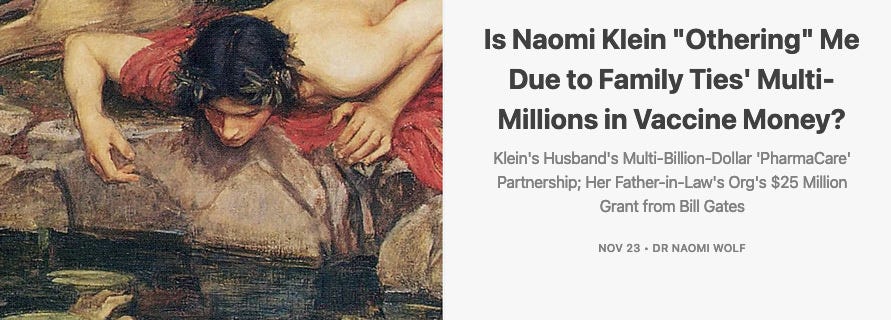
    A screenshot of an article by Substack author Naomi Wolf, that reads: Is Naomi Klein "Othering" Me Due to Family Ties' Multi- Millions in Vaccine Money? Klein's Husband's Multi-Billion-Dollar 'PharmaCare' Partnership; Her Father-in-Law's Org's $25 Million Grant from Bill Gates

    The rest of Wolf’s Substack is the usual wild disinformation kaleidoscope of Covid conspiracies, anti-vax untruth — in her posts, Wolf often lies about vaccines, with special attention paid to the mRNA-based Covid vaccines — and howling about “globalist oligarchs.”

    Wolf has 81K+ subscribers on Substack.

    Let’s move on to another doctor: Dr Sam Bailey! This Substacker bills herself as “the medical establishment’s worst nightmare.” Given her content, it might be true. Bailey, who is a former GP from Christchurch, is best known for appearing before New Zealand’s Health Practitioners Disciplinary Tribunal for producing Covid-19 disinformation on YouTube. She’s since stopped doing so, and she explains why, in a pinned video. 

    “After some reflection, I decided to take all of my videos about Covid-19 off YouTube, and I won’t be posting Covid-19 content on here any longer,” Bailey says. Her reason? YouTube was removing her videos due to their high disinformation payload.

    Luckily for Dr. Bailey — and unluckily, for the “medical establishment,” whose worst nightmare she apparently is — she swiftly found a new, monetized home for her Covid-19 content on Substack.
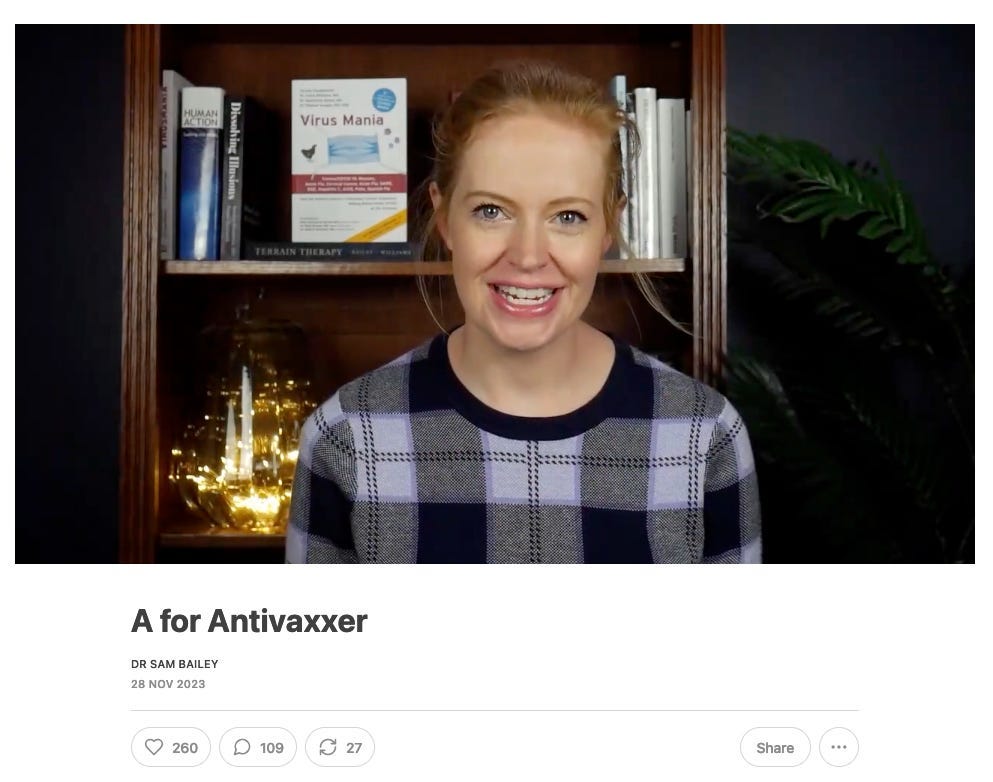
    A screenshot of Substack author Dr Sam Bailey's article, with a picture of Sam, and the headline "A for Antivaxxer"

    Here’s a sample of what she’s selling:

    Many of the older guard anti-vaxxers used historical data to conclusively demonstrate that vaccines cannot possibly be the cause of the vast decrease in sickness and death from many diseases. Now there is a new wave of anti-vaxxers in the tradition of Dr Stefan Lanka who continue to refute not only virus existence but also the wider concept of pathogens. This “upstream” line of reasoning brings down the entire notion of vaccination permanently.

    Vaccines are being exposed on multiple fronts as more people wake up to one of the biggest swindles in history. Is it now time to embrace the “anti-vax” label?

    Bailey doesn’t just lie about the Covid vaccine; she lies about all vaccines. And she doesn’t merely deny the effectiveness of vaccines; she denies that viruses exist.

    Dr. Sam Bailey is a virus denier.

    Dr. Sam Bailey has 16K+ subscribers on Substack.

    Let’s check out Dr Simon’s next recommendation: Vigilant News, by The Vigilant Fox.

    It’s… a lot.
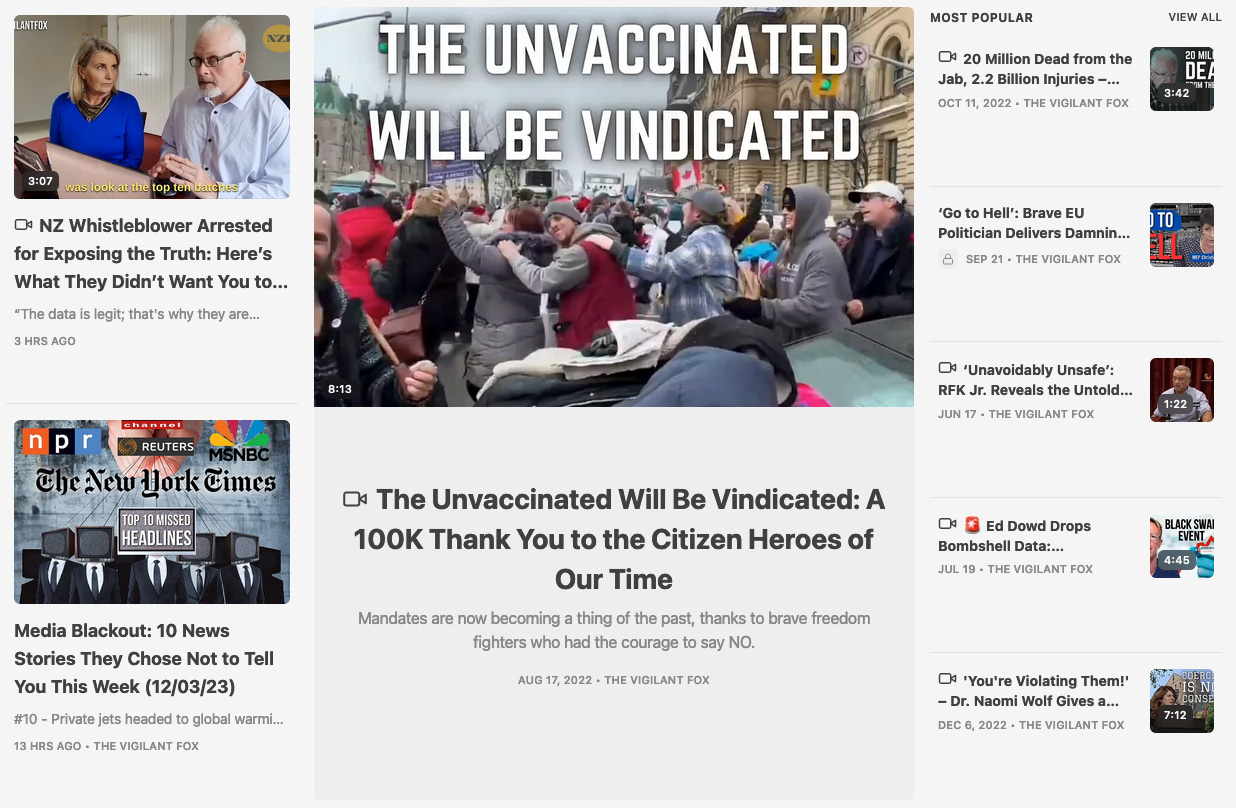
    A screenshot of Substack author The Vigilant Fox's front page, featuring a headline article entitled "The unvaccinated will be vindicated"

    Substack has introduced a tool for writers that lets writers recommend publications, or lets different newsletters “blurb” each other. Let’s see what user “The Farm” of The Farm newsletter has to say of The Vigilant Fox.

    “The Vigilant Fox is one of the single best citizen journalists we have standing up for freedom from the tyrannical sociopaths that are trying to destroy our way of existence.”
    – The Farm, The Farm

    Okay then! What’s The Farm all about?

    A screenshot of the most popular articles from Substack newsletter "The Farm" featuring an article entitled "The Rape of the Mind" and disinformation about Covid vaccines and Ivermectin.

    “The Rape of the Mind,” followed by screeds about Ivermectin? That’s enough. Let’s return to The Vigilant Fox. At the end of his pinned article, a long ramble of virulent disinformation about Covid vaccines entitled “The Unvaccinated Will Be Vindicated,” he has this to say:

    I am proud to announce that I have left my day job to become an independent reporter! If you want to help keep this operation afloat, consider becoming a free or paid subscriber.

    The Vigilant Fox has 49K+ subscribers on Substack.

    My timer is getting close to 30 minutes and I’ve barely scratched the surface of one Substacker’s recommendations. Let’s have a look at Kanekoa News.

    A screenshot from Kanekoa's Substack, with text that reads: Dr. Peter Hotez's Funding Linked to Controversial Chinese Military Scientists ... Funded by Dr. Fauci and Dr. Hotez's R01AI098775 grant, Dr. Shibo Jiang and Dr. Lanying Du collaborated with scientists from the People's Liberation Army...

    Let’s stop looking at Kanekoa News. It’s just more of the same disinformation.

    Kanekoa News has 64K+ subscribers on Substack.

    At this point I’m growing tired of looking at Dr. Simon’s recommendations. The several Substacks he recommends all have their own recommendations, which have their own, and so on, seemingly forever. Almost all of them appear to be some kind of anti-vax disinformation, or science denial, and many have subscribers in the thousands or tens of thousands. All the ones I look at appear to be monetized. Many sing the praises of Substack for giving them a home after being hounded from other platforms.

    So I turn to Bing to see if I can plumb the depths of Substack’s Nazi problem, as written about by journalist Jonathan Katz. (I’d use Google, but the giant search engine seems to have decided that helping its billions of users easily access overtly Nazi content is bad for society.)

    I search for the most obvious, basic stuff. “Nazi Substack.” “National Socialist Substack.” “White power Substack.”

    I find it, easily.

    Let me introduce you to Karl Haemers, author of the newsletter Taboo Truth. Haemers describes himself as a “Researcher, author, secular End Times alarmist, race realist, revisionist, human.” What’s he got to say?

    This article is a vile diatribe against Jews and how best to propagandise against them. It contains the following quote:

    I refer back to Goebbels’ diary quote, which rather says that Whites’ intelligence has been used against them, and our instincts have been subverted by our very intelligence twisted by the Jews.

    So yeah, Karl Haemers is a Nazi.

    He’s got over 700 subscribers, and — at the time of writing, post Substack’s decision to purge a mere five Nazi newsletters — he’s still monetized.

    A little snippet of Substack code under Haemer’s profile says “Timothy Kelly and 100+ others subscribe.”

    Who’s Timothy Kelly?

    He has a paywall on, but the article snippets in his archives are… enlightening.

    A screenshot of Substack author Timothy Kelly's paid articles, showcasing their anti-Semitic content.

    So yeah, he’s a Nazi.

    None of Timothy’s articles appear to be free, so we can reasonably assume that of his subscribers, the majority are paid, or they’re unable to read anything he writes. His Substack-enabled subscription plans start at $8 NZD per month. I counted his subscribers, and he has 258. That means that this Nazi is earning in the ballpark of $2000 NZD per month — more, if any of them are “founding members,” the price per which starts at $385 per year.

    Next, I find The Imperium Press, which is one of those infuriating white supremacist newsletters that — to paraphrase Ken White — is not even occasionally terse. It goes on, and on, and on, in a maddening pseudo-intellectual vein. But eventually we come to the rub:

    These are only a few of the shapes that this default state can take, what Houston Stewart Chamberlain has called the Aryan Worldview. To call it merely “right-wing” is to trivialise it. We call it folkishness.

    I call it Nazi.

    The Imperium Press has 3k+ subscribers on Substack, and — of course — they’re monetized.

    Similarly, the Fascio Newsletter, another Substack I found effortlessly via Bing, is about what they call “Third position politics,” and which is more accurately called neo-fascism. Their entire Substack can be filed as a classic of the “no we’re not fascists, we’re just really really really interested in fascism, and also we agree with a lot of fascism” genre. Their swathe of authors make it difficult to tell exactly how many subscribers they have, but a Substack popup prompting me to subscribe says they have “Over 1,000 subscribers.” They are (of course!) monetized. (The individual writers who comprise Fascio have “2K+ subscribers” each — whether this is individual or as a collective is unclear.)

    Jonathan Katz’s Atlantic article also mentions White-Papers. What’s their deal?

    At White-Papers, our core premise is that White people, the European race, deserves its own voice, its own political institutions and a future free from interference or predation by outside groups. Whites are a global minority and are now becoming minorities in their own homelands. The inevitable and necessary result of this is a growing political movement of explicitly pro-White news outlets, publishers, and political pressure groups.

    So yeah, they’re white supremacists. The little Substack popup that urges me to subscribe says they have “Over 1,000 subscribers.”

    By the end of my hour, it’s clear that there are many, many, many more of these Substacks. Too many, in fact, to list, varying in position from “just really enthused about fascism” to quite overt Nazis. Many — seemingly most — are monetized. Some appear to have paid subscribers in the hundreds; a feat many Substack newsletters (including The Bad Newsletter!) never achieve, and which can produce either a tidy living or very useful source of funds for your movement.

    In short, there are lots.

    A gif of the character Shaun from the film "Shaun of the Dead" saying "Lots"

    I’d like to stop there, but the worst is yet to come. And this one I didn’t find myself. It found me.

    When I posted my version of the open letter Substackers Against Nazis, a commenter showed up with a lengthy screed that used the anti-Semitic slur “kikes.” The author seemed to be searching for Substacks that had posted the open letter and was railing against them. Curious, I clicked on the commenter’s name and found the most overtly Nazi newsletter yet. This one wasn’t hiding behind faux-intellectual essays on Third Positionism, or even trumped-up concern for the “White Race.”

    It was this.

    A screenshot of an article on the Nazi Substack Nordic Pagan Soldier. Hillary Clinton is pictured with an anti-Semitic caricature saying "GOYIM!"

    This Substack, Nordic Pagan Soldier, is raw, unadulterated Nazism. Much of its content is elaborations on the literal Protocols of the Learned Elders of Zion. One post is written in Hindi; translated, it is vile slurs about Jews and Muslims from beginning to end.

    A screenshot of Nordic Pagan Soldier's articles, which include commentaries on the anti-Semitic hoax The Protocols of the Learned Elders of Zion.

    The author’s recommendations for other newsletters run the gamut from Putinist propaganda to an anti-Semitic Qanon podcast (hosted via Substack’s convenient video and podcasting tools). His “Reads” list is extensive — a huge list of conspiracist authors of various stripes. Oh look, Edward Snowden is there too!

    A screenshot of the different Substack newsletters read by the author of Nordic Pagan Soldier - too long for alt text.

    When you subscribe to this Substack, you’re sent a montage of explicitly anti-Semitic text and propaganda posters — put into jpeg form, it seems, as not to trigger spam filters. Don’t worry, the Substack mail always gets through.
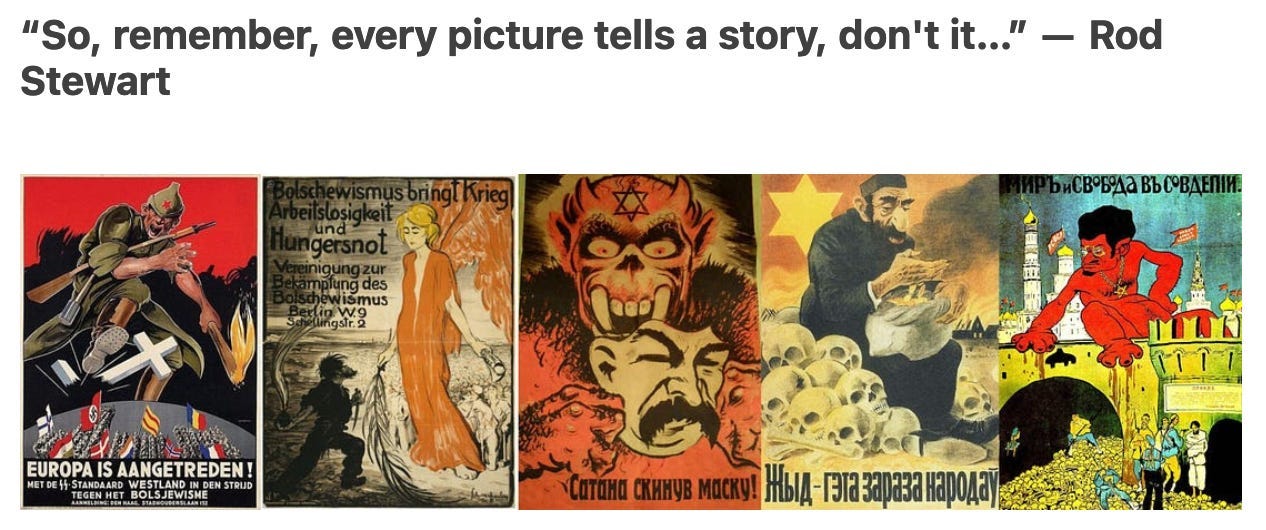
    A screenshot of anti-Semitic posters with the heading "So remember, every picture tells a story, don't it - Rod Stewart"

    Nordic Pagan Soldier has 500 subscribers.

    The author hasn’t turned on paid subscriptions. “I DO NOT NEED THE MONEY AND I NEVER ASK FOR IT,” he says, verbatim.

    But Substack, not to be deterred from a revenue opportunity, offers users the chance to “Pledge their support,” just in case this Nazi ever decides to monetize.

    A screenshot of Substack's "Pledge your support" options for the Nazi newsletter Nordic Pagan Soldier.

    “Join the crew,” Nordic Pagan Soldier urges readers. “Be part of a community of people who share your interests… To find out more about the company that provides the tech for this newsletter, visit Substack.com”

    A screenshot of an About page that reads: To find out more about the company that provides the tech for this newsletter, visit Substack.com. Share Nordic Pagan Soldier People Clarence Wilhelm Spangle "The one aim of these financiers is world control by the creation of inextinguishable debt." - Henry Ford

    This content, and the other things I’ve covered — found either via minimal-effort searches or Substack’s network of recommendations, or (in one instance) a Nazi commenter just kind of announcing themselves on my newsletter — is the tip of the tip of the iceberg. In fact, “iceberg” is being a bit too nice. This is a garbageberg; a disgusting collection of the worst disinformation and filth. It’s like if 4chan and 8chan and Kiwi Farms offered a cutely-monetized email subscription option. It gets worse: I haven’t even mentioned the larger disinformation spreaders, as covered by the Washington Post.

    This type of content is “so bad no one else will host it,” said Imran Ahmed, CEO of the Center for Countering Digital Hate, a nonprofit that focuses on combating misinformation and has researched Substack. By splitting subscription profits with creators, the group estimates, Substack generates at least $2.5 million a year in revenue from just five anti-vaccine leaders who have amassed tens of thousands of subscribers, each paying $50 a year.

    The publications I’ve listed above — which seemingly represent a very small slice of Substack’s disinformation ecosystem and which I was able to discover in just one hour of work — boast 231,485 subscribers between them, by my count. Almost a quarter of a million people. If we assume a fairly standard proportion of these subscribers are paid (let’s say 10 percent) and assume they charge $8 NZD per month each, that’s $185,189 NZD a month — more than $2 million a year in revenue to the disinformers, and a non-insignificant $222,226 annually to Substack, via their 10 percent cut. Add that to the millions Substack makes from the biggest liars (as per the Washington Post) and it’s clear that disinformation of all kinds is a huge market for Substack.

    In fact, it makes me think Substack might be primarily a disinformation ecosystem — with a bunch of credible writers bolted on, to be the acceptable public face of a company that exists mainly to monetize the internet’s limitless supply of garbage.


    I did the research and early drafting for this article several weeks ago. I sat on it, hoping that Substack would ban — at least! — the overt white supremacist and Nazi publications. I hoped that the disinformation newsletters might get demonetized.

    At the time of writing, all the publications I found in my hour of research were still active. They seem keenly aware of the controversy around their content, and they’re cheering on Substack, who they clearly see as an ally. Don’t take my word for it: here’s Nazi newsletter Taboo Truth:

    A screenshot of Nazi Substack Taboo Truth, with the headline "Warning, (((They))) Are After Substack"

    Like too many other users of Substack’s Twitter clone, Notes, Taboo Truth’s favourite thing after fascism seems to be posting graphs of his subscriber numbers.

    A screenshot from the Taboo Truth website, with anti-Semitic ranting about Jews and boasting about subscriber numbers.

    I’d like to find out more, but this is all I can manage for now. I do all this in my spare time, and yet it’s clear more research is needed. I hope someone who has more than a few hours to hand can do it. If I had time to accurately quantify my opinion that Substack is a significant player in the world’s disinformation ecosystem, I’d start by getting a list of all the websites that live on the .substack.com subdomain, identifying which had more than 100 subscribers, and running a mechanical turk-powered content analysis to see which are disinformation, TERFs, Nazis, or similar. It’d be a big job. Sadly, it seems that unless Substack opts to proactively inform the public about the role it plays in spreading disinformation, that’ll be the only way we’ll find out.

    I want to close with an apology. I really liked Substack. It gave me the chance to write what I like and have my work seen: something every writer wants. I was enamoured to the point of inviting several friends to the platform — some of whom became quite big publishers. But in doing so I ignored the voices of critics, including trans people, who pointed out how Substack had purposely recruited prominent TERFs to the platform, to spread their particularly cruel form of contagious disinformation against some of the world’s most vulnerable communities.

    People like Glinner.

    Of course, he’s still on Substack.
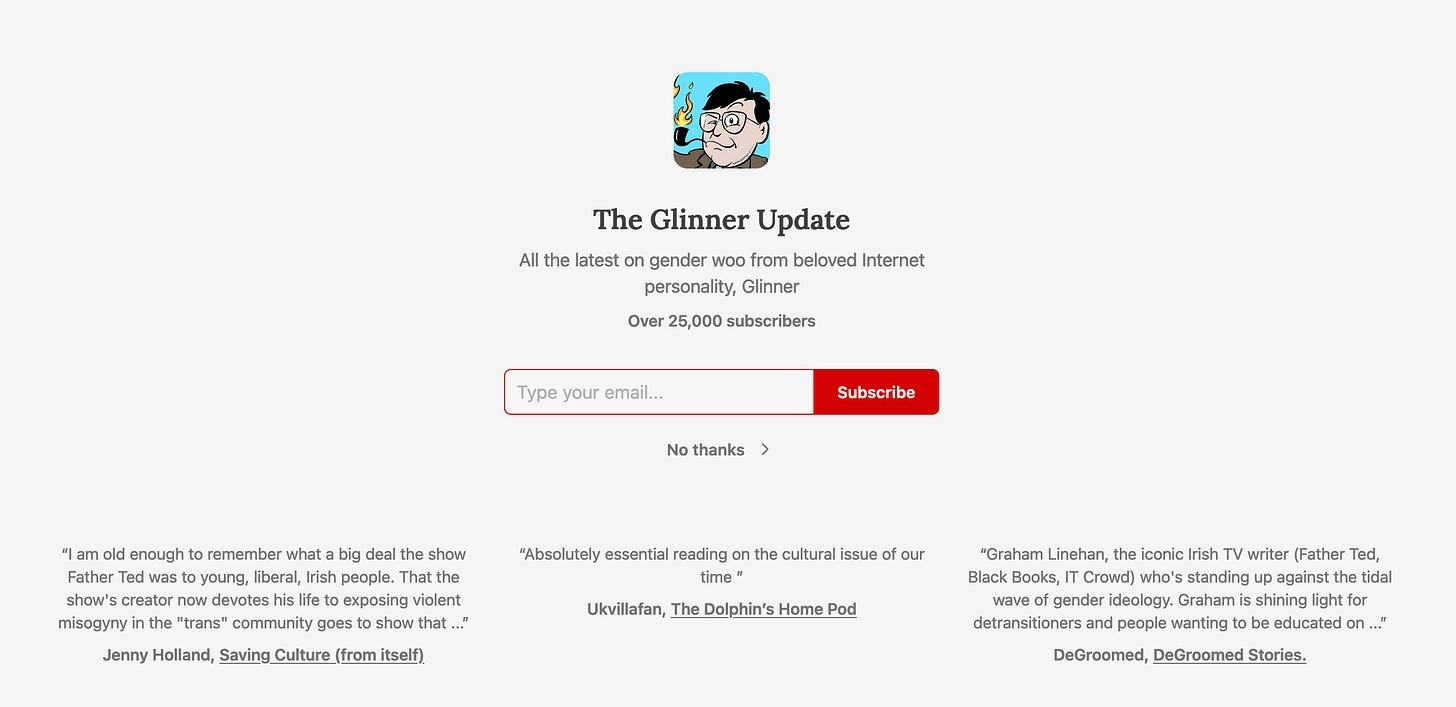
    An image of beloved internet personality Glinner's About page on Substack
    “Beloved internet personality”

    Here’s Glinner on his “About” page — probably one of the first things he wrote on joining Substack — indulging in the usual transphobia, denigrating those who’ve chosen surgery to help with gender dysphoria, and falsely insinuating that trans activists are coming to mutilate children.

    It was only children who needed to place themselves on those hospital trolleys. As Alex Drummond famously said ”The thought of surgery terrifies me”, and as Magdalen Berns famously replied, “Of course it terrifies you, Alex. They chop your cock off.”

    This sort of thing is horrible. But it’s been part and parcel of Substack since the beginning.

    Until now, we just chose not to notice.


    Post-Ghost Update

    One thing I regret not mentioning in the original article is that there is a common theme in Substack’s taxonomy of garbage content: transphobia. The Q conspiracists are transphobic, the Covid cranks are transphobic, the Islamophobes and the anti-Semites and the white supremacists and the overt Nazis are transphobic. (Perhaps needless to say, Glinner and his fellow TERFs are transphobic.) Transphobia is, almost invariably, the one thing that binds them all. I find that very telling, and deeply worrying.

    What’s more, the sheer depth and breadth of Substack’s disinformation ecosystem is becoming more and more apparent. An author whose work I enjoy, Melanie Newfield, pointed out that Substack has thoughtfully provided a really easy way to find medical disinformation: the “health politics” filter in its prominent “Explore” tab. How bad is it? Really bad:

    These disinformation newsletters include some of the biggest Substacks of all. In February 2023, the Press Gazette reported that many of the highest-earning Substack newsletters were health disinformation:

    The analysis affirms previous reporting suggesting Substack has become a lucrative revenue stream for writers with fringe views. For example, Covid-19 vaccine sceptics Robert Malone, Steve Kirsch, Alex Berenson and Joseph Mercola all appear among the most lucrative Substacks.

    Each of these newsletters, the Press Gazette estimated, could have earnings anywhere between $500,000 and a colossal $4,999,950, every single year. And this was before Substack launched many of its network growth features, so those figures could be even greater by now. By any count, the named writers are getting rich from spreading disinformation, and so is Substack, via its tidy 10 percent cut of all author earnings.

    It seems clear that this is why Substack doesn’t want to “censor” transphobia, conspiracies, health disinformation, and even Nazis (despite being perfectly happy to ban porn: you can’t do sex work on Substack). It’s not about free speech: it’s because they’re making far too much money from all of it. It really looks like spreading disinformation is the cornerstone of their business, and that’s not something I’m prepared to support.


  • Coming now: the Ghost-powered Bad Newsletter

    Coming now: the Ghost-powered Bad Newsletter

    This is The Bad Newsletter, a brand new version of an old site by Joshua Drummond that’s just migrated from Substack. Things will be up and running here shortly, but you can subscribe in the meantime if you’d like to stay up to date and receive emails when new content is published!

  • Are New Year’s resolutions doomed to fail?

    Are New Year’s resolutions doomed to fail?

    You’ll have no doubt heard that only a small percentage of people who make a New Year’s resolution manage to keep it. It’s a piece of pop dicta, repeated endlessly in the period just before December 31 by media in desperate need of an easy factoid to recirculate for clicks. And debunking popular notions like New Year’s Resolutions sure does get clicks. Here’s an extract from a typical article, from the venerable Time:

    And yet, by some estimates, as many as 80% of people fail to keep their New Year’s resolutions by February. Only 8% of people stick with them the entire year.

    This depressing factoid has lived rent-free in my head with a bunch of others, like an anarchist squatter commune of bad vibes. If true, there’s an high chance you’re half-way to quitting whatever it is you resolved to do by now. I thought about writing an article about it, but I didn’t feel like dancing on the graves of people’s New Year hopes and dreams. Because as much as we tell ourselves ‘“it’s just another day,” it’s not, is it? The cultural gravity of New Year is, for Westerners, as inescapable as a black hole. And how could I write an article on how most resolutions fail, when the proof that they don’t always is right in front of us?

    An image of a tweet that reads "Jessica 'Donnell happy 2023, yall. trust God. spend time with family. don't give up your rights. shoot guns and watch college football" superimposed with a gunshot foot covered in a bandage.

    I’ll level with you. This article was originally inspired by seeing the above image in an Instagram story, upon which I Googled it, and found this Daily Dot article, in which the author says:

    Most people give up on the resolutions about 10 days in. Instead, O’Donnell appears to have accomplished hers.

    Classic internet “it’s funny cos it’s mean” snark, worthy of Gawker circa 2009, right? But the claim – perhaps because it was associated with an image of a pro-gun person who literally shot themselves in the foot — stayed in my mind, limping into my mental commune of received wisdom. I’d heard it so many times before. It has to be true, right?

    Because this isn’t the Wide-Eyed Eternal Optimist’s Guide To Self Improvement, you’ll have guessed where I’m going with this:

    The suggestion that only 8 percent of people ever achieve their resolutions, or that as many as 80 percent fail to keep resolutions by February, or that “most people give up on the resolutions about 10 days in” is bunk.

    The first clue was clicking on the link in “by some estimates, as many as 80% of people fail” led not to a scholarly paper but another webpage, and clicking on the sources cited in that page and subsequent pages ended up with a dead link. That alone wouldn’t clinch it. What did, though, was that searching for “new year’s resolutions” and similar phrases in Google Scholar didn’t turn up any kind of widely-cited statistic around resolution success or failure. Like so much else in psychology, the truth is harder to pin down than self-improvement pop science might have you think. Nor are “success” and “failure” binaries, in the context of resolutions. A 2020 PhD thesis on NY resolutions by Hannah Moshontz de la Rocha, a student in the Psychology and Neuroscience in the Graduate School of Duke University, found that:

    Goals varied greatly in their content, properties, and outcomes. Contrary to theory, many resolutions were neither successful nor unsuccessful, but instead were still being pursued or were on hold at the end of the year. Across both studies, the three most common resolution outcomes at the end of the year were achievement (estimates ranged from 20% to 40%), continued pursuit (32% to 60%) and pursuit put on hold (15% to 21%). Other outcomes (e.g., deliberate disengagement) were rare (<1% to 3%).

    Those figures are… pretty good, actually? 20 to 40 percent of people achieving their goal by year’s end is a lot better than the pessimistic received wisdom that most people give up by February.

    Likewise, a user at Skeptic’s Stack Exchange has done the legwork on the claim that only 8 percent ever achieve their resolutions, and found it to be at best misunderstood and at worst wildly cherry-picked:

    The real source of the 8% number appears to be a survey conducted by Stephen Shapiro, a management consultant, author, and speaker, and published in an article on his website. According to him,

    Only 8% of people are always successful in achieving their resolutions. 19% achieve their resolutions every other year. 49% have infrequent success. 24% (one in four people) NEVER succeed and have failed on every resolution every year. That means that 3 out of 4 people almost never succeed.

    Of course, “Only 8% of people are always successful in achieving their resolutions” is not the same as “8% of People Achieve Their New Year’s Resolutions”. The study by Shapiro has not been published in a scientific journal.

    Thanks, Stephen! Your literally incredible claim has poisoned a huge swathe of the internet when it comes to New Year’s resolutions, and (this is my own conjecture) led to a kind of low-key seasonally affective depression amongst those of us who’d like to make a lifestyle change around a culturally auspicious date.

    If you’re in that cohort, rest easy. The takeaway is pretty clear: if you want to make a New Year’s resolution, feel free to. You may as well! The achievement/still working on it/still pursuing it statistics seem perfectly acceptable to me: clearly there’s some weight to the things. And it’s not too late: I unscientifically consider the “New Year” period to occupy the whole month of January, because that’s the span in which the year still feels new. I could add some stuff about setting SMART goals, or just making sure that your progress is in some way measurable, but that would be very boring and like every other article on the topic and is something you (an intellectual) probably already knew.

    So I’ll just put in some potential resolutions you’ll hopefully have no trouble keeping.

    Resolve not to start going to the gym in January

    Look, just don’t. Especially if you’ve never gone before. There is much to be gained from lifting weights, including (obviously) muscle, but in my experience the gym in January is a Bad Time. Everyone who made a resolution to “go to the gym more” is there, hogging the machines or giving themselves renal failure from trying to deadlift too much, sweating and grunting and selfie-ing. It’s not worth it.

    If you’re a regular, you might choose to power through it, but if you’re a total newbie, save the money on gym fees and buy a broomstick. It’s not a witch thing and I’m not joking. You want to learn how to lift weights before you lift any actual weight, and here the incredible Swole Woman, Casey Johnston, has you covered.

    Resolve not to “lose weight”

    This isn’t my area of expertise, but I’ve listened to enough people for whom it is to know that “losing weight” purely for the sake of losing weight is — for the vast majority of people — a toxic concept that can easily ruin lives. Food is good, you need it to live, and as a general rule if you’re exercising you need to be fuelling yourself properly. There are plenty of people who know better than me on this so I’m just going to recommend Casey Johnston again.

    Resolve not to “do something every day” unless it’s very automatic or very low effort

    You can’t move without this shit. “Go to the gym every day.” “Do X push-ups every day.” “Practice Y every day,” or my personal bugbear that I can’t swear off swearing to do: “do art every day.” So let me draw a line in the sane for myself and possibly you too: can we not? Unless it’s for something like “drink water,” or “poop,” committing to do something every day seems a fast track to the kind of demoralizing failure that only comes with overcommitment.

    Take “Gym every day.” A moment’s critical reflection will reveal this goal to be both wildly improbable and useless. You’re going to get crook. You’re going to have a family thing come up. You’re going to get a flat tire. At some point, the gym will be inconveniently closed. Letting any of these all-but-inevitable and entirely reasonable life events ruin your resolution because you didn’t tick off all 365 days in the year isn’t worth it. A vanishingly small subset of people either need to go to the gym every day (actors, bodybuilders, influencers in the field of same) or will get any tangible benefit from doing so. For nearly everyone else, working out daily is a fast track to ruined health, because you’re not taking vital recovery time. Your Average Joe, including very much me, will do better resolving to “go to the gym several times a week, with at least a day’s rest in between sessions, and obviously not when sick” or something similar.

    The same applies to art. Long, bitter experience teaches that if you try arting every damn day you’ll start hating art and everything adjacent to it. Of course there are exceptions to this rule, and if you’re one of those people who can do something out of the ordinary every day, more power to you — but all I’m aiming for this year is mostly consistent consistency.

    Resolve not to get your New Year’s resolution effectiveness information from websites that don’t cite their sources, or management consultants

    You probably didn’t need me to tell you that.

    Here’s a watercolour seascape I did, because I needed an illustration for the newsletter’s thumbnail image.

    Thanks for reading. This newsletter likely won’t be on Substack much longer, due to their cataclysmically awful handling of an entirely self-inflicted Nazi/TERF/active disinformation ecosystem controversy, and (less importantly) the fact that they’d rather dabble in AI bollocks than offer basic email composition features like a native spell-checker. In short: it’s them, hi, they’re the problem, it’s them. Barring a policy u-turn, and a spell-checker, chances are I’ll move it to another provider in the next few weeks. If you do subscribe here, either free or paid, don’t worry. You shouldn’t see much of a difference, and I’ll be choosing a platform that enables comments so our discussions remain as fun and enlightening as they’ve been here.

    In the meantime, comment away! It’s great to have you here in 2024. It’s only the 12th of January, and it feels like a whole year already.

  • Why is Stuff promoting right-wing propaganda?

    Why is Stuff promoting right-wing propaganda?

    The way New Zealand’s Taxpayers’ Union works should be obvious by now. This fake union — which is actually a neoliberal, ultra-capitalist lobby group acting in concert with a dense network of international right-wing think tanks called the Atlas Network — advances its agenda by carefully picking divisive issues and laundering them through the news media. Every story they land in a mainstream publication is a victory for them, and thanks to the news media’s addiction to conflict and its diminishment by market forces, the fake union and its think-tank bedfellows are having an easier ride than ever.

    It probably shouldn’t be this easy, though. Witness this glorified press release masquerading as a story in Stuff, published on Christmas Eve, in the heart of the silly season:

    A screenshot of a Stuff news page that reads: Which council staff are earning more than $100,000? Susan Edmunds • 05:00, Dec 24 2023 PETER MEECHAM Auckland Council has the most staff earning six figures.
    Merry Christmas, council workers! Your present this year is the Taxpayers’ Union talking about how you should be sacked, via the increasingly beleaguered Stuff, which has just disestablished much of its investigative journalism team.

    The story itself is… boring. The first bit is based squarely on (via what looks some heroic paraphrasing to avoid outright copying) a Taxpayers’ Union press release. The fact that some council staff earn over $100,000 is framed as shocking, when in fact it’s wildly unsurprising; the people who run cities and towns are doing a demanding job and they’re (sometimes) paid well for it. And that’s what the article itself says, a third of the way through, citing Infometrics (an economic consultancy based in Wellington.)

    Infometrics chief forecaster Gareth Kiernan said he would expect roles in larger councils to be paid more than equivalent roles in smaller councils, particularly at the higher levels.

    Near the end comes a missive from Connor Molloy, Campaign Manager for the Taxpayers’ Union (who are not identified in the story as anything other than “the Taxpayers’ Union,” with no explanation for readers that the “union” is a right-wing lobby group.) Molloy, of course, seems to think that the best Christmas present for council staff is for them to lose their jobs:

    Connor Molloy, campaigns manager for the Taxpayers’ Union, said reducing the number of highly-paid “backroom” staff was the right thing to do if councils were threatening big rate hikes.

    “Rather than going straight for core services like rubbish collection and libraries, councils ought to look inwards at their own bloated bureaucracies first when looking to make savings.

    From a quick scan, this story seems like merely another example of the TPU successfully “placing” a piece of its neoliberal propaganda in the media, which happens — to the media’s vast detriment — all the time. But on a closer look, things get even bleaker.

    Reading the story, a little blue hyperlink in the opening paragraph caught my eye, as it’s designed to do.

    A screenshot of text that reads: More than 10,000 council staff across the country earn more than $100,000 a year, and in many councils more than 20% of the staff earns six figures. The data is included in the Ratepayers' Report, which is produced by the Taxpayers' Union. It shows that, in total, at least 10,378 council workers are paid more than $100,000 a year, although some councils, such as Horizons Regional Council and Whakatäne District Council, did not provide data.

    Curious! I wanted, as many readers might, to see the raw data informing the story. I was mystified as to why Stuff weren’t just hosting it themselves, or embedding the data on their page, as is standard practice for news organisations, which just made me curiouser.

    I clicked through.

    The page I landed on looks like this.

    A screenshot of the Taxpayers' Union Ratepayers' Report

    Hmm. Looks like I just need to put my email address in this handy form and I’ll get to see the report! You can even choose to be one of the three types of person: an “Elected official,” “Ratepayer,” or “Journalist (or reseracher.)1”

    I’ll just pop my details in and click “VIEW REPORT” and…huh? It’s just a normal webpage! No need for an email address at all!

    A screenshot of the Ratepayers' Report, showing the URL

    Look at that URL. That’s not a hidden or gated page: if the website was designed to be user-friendly, you could navigate straight to it. You don’t need to put in an email address to access the data, but the page is designed explicitly to make it seem like you do.

    Do you at least get emailed the report? Like hell. Nothing shows up in your inbox until a few days later, when a horrifically-formatted email arrives and it’s made clear you’ve been added to a Taxpayers’ Union mailing list.

    A horribly formatted email from the Taxpayer's Union, sent to unwitting users of the Ratepayers' Report

    Take another look at that first form up there. There’s nothing whatsoever to indicate that you’re signing up to a mailing list. Not even a pre-checked “yes, send me Taxpayers’ Union emails,” checkbox. It’s either very poorly designed or deliberately misleading: either way, it could easily be illegal, under New Zealand’s Unsolicited Electronic Messages Act (2007).

    So this is where we’re at. Stuff isn’t just parroting Taxpayers’ Union propaganda and enthusiastically leaning in to their “government = waste = fire them all” framing; they’re encouraging their readers to visit a website that harvests their emails and, unasked, signs them up for the full TPU package.

    If you’re thinking “this seems bad!” well, I have more: want to know where this overtly propagandistic Ratepayers’ Report that shills for a right-wing lobby group originally comes from?

    It was born as a collaboration between Stuff and the Taxpayers’ Union.

    Don’t take my word for it: here’s the TPU press release.

    The New Zealand Taxpayers’ Union, in collaboration with Fairfax Media has today launched “Ratepayers’ Report” hosted by Stuff.co.nz (…) “For the first time, New Zealanders now have an interactive online tool to compare their local council to those of the rest of the country,” says Jordan Williams, Executive Director of the Taxpayers’ Union. “Ratepayers can visit ratepayersreport.co.nz to compare their local council including average rates, debt per ratepayer and even CEO salaries.”

    That was back in 2014. But at least the 2014 Ratepayers Report was hosted on Stuff’s own site, and didn’t speciously sign its users up to spam. It looked like this:

    The old Ratepayers' Report site, hosted by Stuff, as it appearecd in 2014.

    Nearly a decade later, the Ratepayers’ Report, together with a payload of TPU propaganda, is embedded in news cycles. The Taxpayers’ Union puts it out regularly, and media publish obligingly. A Google search of the Stuff site for “Ratepayers’ Report” shows you how entrenched it is.

    A page of Google results from the Stuff.co.nz site for "Ratepayers' Report"

    This is how the Atlas Network right-wing sausage factory works: their junk “think tanks” propagate their neoliberal message and exploit the decline of media by doing journalists’ work for them. They’ve been doing it for years, and it’s been wildly successful, to the point that they’ve just released a book skiting about how manipulative they are. But this — a reputable news site sending its readers to sign up directly, and probably unknowingly, for TPU propaganda — seemed beyond the pale. What was going on? I wanted to know, so I put the following questions to Stuff.

    • Why is Stuff linking to a Taxpayers’ Union email harvesting site?
    • Was Stuff aware that the function of the Ratepayer’s Report was at least partially to harvest emails for the Taxpayers’ Union?
    • What is Stuff’s policy on linking to external sites, especially those that may act maliciously or harvest user details?
    • In your view, was the nature of the Ratepayer’s Report website (and its email-harvesting capability) sufficiently disclosed to readers?
    • What is the present nature of the relationship between Stuff and the Taxpayers’ Union?
    • Referring to the press release above, what is the past nature of the relationship between Stuff and the Taxpayers’ Union?
    • Was this a commercial relationship, i.e. did either TPU or Stuff pay each other for participation in the Ratepayer’s Report? Was there contra, or an exchange of services?
    • Does the relationship between Stuff and the TPU that established the Ratepayer’s Report persist today?
    • If not, when did it end, and why did it end?
    • Does Stuff have guidelines for journalists (or editors) who utilise the work of lobby groups in their stories, perhaps along the lines of the BBC? I refer to this page, which states:

    Contributors’ Affiliations

    4.3.12 We should not automatically assume that contributors from other organisations (such as academics, journalists, researchers and representatives of charities and think-tanks) are unbiased. Appropriate information about their affiliations, funding and particular viewpoints should be made available to the audience, when relevant to the context.

    If so, can you please provide me or point me to a copy of these guidelines?

    Further to the above question, why does the story not identify for readers who the Taxpayers’ Union is, and what their work entails? I refer to these Newsroom stories that make it clear that the TPU is a neoliberal, right-wing lobby group, with links to fossil fuel and tobacco concerns, as well as being part of the international Atlas Network of neoliberal, right-wing think-tanks.

    I note also that this Stuff story (correctly) identifies the Taxpayers’ Union as a “right-wing pressure group,” so clearly it’s possible to be upfront about the group and their motivations when writing a story about the TPU’s work and the concerns they raise. Given this, why isn’t this clear identification the norm across Stuff?

    A day later, Stuff replied, with a comment they asked to be attributed to Keith Lynch, Editor-in-Chief of Stuff Digital:

    Stuff has no formal relationship with the Taxpayer’s Union. A report from the Taxpayers Union was transparently quoted in the story alongside information from other named sources. In this case, the link to the source was included so audiences could access the information referenced in the story, should they wish.

    On reflection, we have now updated the story to remove the link.

    There you go, Stuff readers: four sentences and one middle finger. Wondering why Stuff saw fit to partner with the TPU? When the partnership ended? Why it ended? What their guidelines are when handling the journalistic equivalent of radioactive waste — the propaganda created by think tanks to shape society in their image? Screw you. You don’t get to know. The hyperlink to the Taxpayers’ Union site that misleadingly harvests readers’ emails is gone (without so much as an edit notice or correction on the page) because it should never have been there in the first place — but as for the merest whisper of explanation as to why the TPU so often gets such an easy ride in media?

    Nothing.

    I replied, asking Stuff if they’d be giving my other questions actual answers. I didn’t hear back. It’s amazing, really: journalists hound politicians endlessly to just Answer The Question (as they should!), but when it’s them on the hook they provide weasel words that’d do any politician proud, and then evaporate into the ether.

    Going back to the Stuff story one last time, I saw this little banner above the body copy.

    A banner that reads: We care about your money. How about supporting that work? Contribute to Stuff

    You care about our money? I bet you do. Here’s a thought, Stuff: how about showing that you care about your audience? Stop feeding them repurposed think-tank propaganda, own your mistakes, and act with integrity. Perhaps, instead of taking the Taxpayers’ Union at their obviously-compromised word, you could talk about how the TPU used racist insinuations about “co-governance” to fight Three Waters, a government program designed to fix horrifically neglected water infrastructure while freeing councils from paying for it — the repeal of which is now being cited by councils as a key reason for massive rate hikes.

    Maybe then people would be more inclined to pay you, instead of mistrusting you.

    In a world where misinformation is so easily spread, the mainstream press should be fighting it, not amplifying it. It’s too bad that Stuff seems incapable of assuring its readers that it will treat think-tank content with the caution it warrants.


    1. Sic. ↩

  • A Simple Nullity

    A Simple Nullity

    An incredibly important documentary went live today, and I don’t want you to miss it.

    “Trick or Treaty? Indigenous rights, referendums and the Treaty of Waitangi” is a deep dive on how right-wing influence networks in Australia joined forces to destroy Australia’s Indigenous Voice to Parliament — and how the same forces are at work in New Zealand. I’ve taken an interest in New Zealand’s gaggle of lobby groups for a long time now, so I was very pleased to do research for the doco and work with award-winning producers and top-tier journos Mihingarangi Forbes and Annabelle Lee-Mather. I also appear on camera, which is less my thing, but as an Aussie-born Kiwi the subject is very close to my heart, and I didn’t want to miss the chance to tell what I think is a vital story.

    Much of what’s in the doco is far from secret, particularly to those in the media-politics confluence; but (crucially) it is not well known by the general public. The short version is that there are a bunch of well-funded, right-wing, neoliberal influence and lobbying groups in New Zealand, who share links with similar groups overseas. They are ostensibly independent groups, but they coordinate their activities, share resources, trade personnel, and — when you zoom out slightly — essentially work as one large body. In fact, several of the groups officially operate under the auspices of one giant neoliberal anthill organisation, called the Atlas Network. In New Zealand, these groups — and the individuals who work in them — tend to cluster around parties like ACT, NZ First, and National. Their modus operandi is to write stultifyingly dull papers, create model legislation, get pet MPs and parties elected, and incessantly insert their messaging into the public consciousness via the media. That messaging varies from group to group, but the (almost invariable) common denominator is this:

    They consistently oppose both climate action and recognition of indigenous rights.1

    Having seen extraordinary success in Australia with the triumph of the “No” vote on the Voice, these same forces look to be coming for Te Tiriti o Waitangi. Since it gained limited judicial and legislative recognition, Te Tiriti has been a bugbear for neoliberals. It represents everything they hate: an example of collective recognition and responsibility, and an admission that indigenous people do in fact have continuing inalienable rights that pre-date colonisation. Perhaps most importantly, Te Tiriti acts as a potential handbrake on the kind of unfettered property rights required for mining and fossil fuel companies to prosper.

    So it’s no surprise that the ACT Party and lobbyist enablers like Hobson’s Pledge want nothing more than to get rid of it.

    Wherefore referendum

    In the doco, I’m asked if I think there will be a referendum on Te Tiriti. My answer is yes: in my opinion, it only really remains to be seen what form the referendum will take. There are two options: a government-initiated referendum or a citizens-initiated referendum. For the first option: the coalition agreement between National and ACT specifically calls for ACT’s Treaty Principles Bill to be advanced to select committee: National have pointedly not committed to a referendum but to ACT Party leader David Seymour, it’s clearly still on the cards.

    The other option is a citizen’s initiated referendum or CIR: anti-Tiriti group Hobson’s Pledge, co-founded by former ACT Party leader Don Brash, is already lobbying for one. Anyone can get a CIR before Parliament; all that’s required is the signatures of ten percent of registered voters. For an issue like Te Tiriti, long a lightning rod for cranks, racists, and the terminally uninformed, 370,000-ish signatures should be a snap.

    In my opinion, either option stands a very real risk of ripping the country apart, on a scale not seen since the Springbok tour protests or perhaps even the Land Wars. And I also think that ACT’s proposed Treaty principles — on top of the other anti-Tiriti measures being undertaken by the ACT/NZ First/National government — would be the most profound assault on indigenous rights in Aotearoa since the racist Justice James Prendergast declared the Treaty a “simple nullity.”

    Maps of Meaning

    In the doco, there are a few shots of me using a program that looks like a digital spiderweb. I like that it’s been included, because it’s becoming a big part of my writing process. Obsidian is a note-taking program that allows users to write in Markdown, and easily link notes to each other. I’d recommend it to journalists everywhere — it’s encrypted, open-source, and great for brain-dumping and research. One of its nifty features is its mind map or “graph view,” functionality, which showcases all your notes and how they link to each other.

    That, I’m very aware, is essentially a computer version of this:

    Charlie Conspiracy (Always Sunny in Philidelphia) Memes ...

    Mind maps have a bad name, thanks to conspiracy theorists and very funny sketches based on conspiracist antics, but they’re a really useful visual tool for research. What’s obvious on viewing the mind map I’ve made — which, to be clear, is comprised primarily of publicly-available information listed on the websites of the organisations I’m researching — is just how entwined everybody is. New Zealand is a small country, to be sure, but after a few hours it becomes very clear that the favourite hobby of these lobby organisations is giving each other jobs. The boards are stacked with fixtures of the “business community” — the very elites that these same organisations so often rail against — and a scan of member’s employment histories often reveals them bouncing around related orgs like pinballs. New NZ First MP Casey Costello, to pick one name more or less at random, has previously worked for (or with) the Taxpayer’s Union, Hobson’s Pledge, and ACT. Each organisation is so entwined with the others that they start to look, accurately, like the same body.

    The media is the message

    One of the best things about this documentary is that it gives New Zealanders something Australians missed out on: a primer on who these interconnected neoliberal groups are and how they operate. While they have many channels to their audience, like newsletters and social media, the most important medium is still the mainstream media. One of the things I said during shooting that didn’t make the final cut is that the New Zealand media is “infected with lobbyists” — and it is. Lobbyists and their ilk advance their agenda in the media through the following methods:

    1. Giving journalists their phone numbers and never failing, as I mention in the doco, to pick up when it rings, to deliver some variation on “the world’s richest and most sociopathic people are right, actually.”
    2. Combining a never-ending deluge of press releases with juicy scoops and leaks of the “ya didn’t hear it from me but boy have I gotta story for YOU. You’ll never guess how much funding this poet got!” variety, usually supplied to pet journalists and right-wing media orgs who can be relied upon to advance the lobbyist’s agenda. See also: Newstalk ZB.
    3. Providing enticingly conflict-loaded “insider” opinions for free or very cheap to cash-strapped editors and producers, with the tangible result that a huge proportion of New Zealand’s opinion columnists, podcasters, and other varieties of talking head are paid lobbyists of some kind, which brings me to:
    4. Getting actual media jobs, which has everything to do with a laissez-faire media culture that pretends not to notice the constantly revolving door at the axis of business, politics, and journalism. Numerous examples include New Zealand Institute asset Luke Malpass waltzing into the job of political editor at Stuff, a position he wields with all the impartiality of a used car salesman; ex-National leader Simon Bridges failing into a podcast at Stuff; New Zealand Institute sleep aid Eric Crampton’s spot at Newsroom; Muriel Newman (the founder of unhinged climate-denying lobby group NZCPR) being slung a new gig at Newstalk ZB; long-time right-wing lobbyist Matthew Hooton getting a seemingly eternal opinionist gig at NZME; and his (current? former? I don’t know, and neither do you, because the media outlets he appears on often don’t deign to tell us) consigliere Ben Thomas, who rejoices in the lifetime appointment of Chief Migraine Officer on the Spinoff’s exhausting political podcast, Gone By Lunchtime.

    Given the noble Fourth Estate functions essentially as a base of operations for influence operators, what can be done? Lots, in my opinion:

    1. Short of proper lobbying finance and influence disclosure law, which are all but impossible under the present Government but might be an option when they disintegrate, the media can start by voluntarily and transparently showcasing the bona fides of its talking heads. Every time a lobbyist shows up to generously peddle influence and build their own profile, their appearance can be marked with a disclaimer showing exactly who they have a.) previously worked for and b.) are working for now. That’s really the least that should be done: audiences desperately need to know which talking heads are on the take2.

    2. News media can also choose to identify when stories have been shopped to them by members of astroturf influence organisations like the Taxpayer’s Union, or (more ideally) refuse to run their hit pieces.

    3. Media should identify and label influence groups accurately: for example, identifying a spokesperson as being from the benign-sounding “New Zealand Institute” tells an audience nothing: labelling the New Zealand Institute (accurately) as a “neoliberal lobby group for ultra-free-market economics with representation from some of the biggest corporates in New Zealand on its board” tells audiences what they need to know.

    4. Media should also proactively highlight when their employees are intimately linked to lobby groups or politicians, which is (especially in the Press Gallery) much more common than non-media people might think. Such is the case with Newshub’s Political Editor Jenna Lynch, who is married to ACT Party Chief of Staff Andrew Ketels. It doesn’t matter if she’s the world’s most scrupulous reporter who somehow manages never to discuss politics with her husband: it’s a very obvious potential conflict of interest, and audiences deserve to know about it — and any other such conflicts.

    5. As a final suggestion, the media should also stop giving prime opinion and airwave real estate to the world’s most boring politicians because of the more-common-than-you think reasoning of “oh, they were such a hoot when we got on the piss that one time.” Their audiences will fervently thank them.

    Thanks for checking out the documentary. Please share it far and wide: I think there’s a lot in there that New Zealanders both deserve and need to know.


    1. The New Zealand Initiative hotly denies they are climate deniers, by pointing out that they accept the reality of climate change and that they support the Emissions Trading Scheme, but they also lobby stringently against any and all climate action that isn’t the ETS. This is easily understandable given the fact that that the ETS is set up as a literal licence for corporations to continue with carbon pollution, as well as a way for the rich to get richer trading in carbon credits. ↩

    2. In this spirit of transparency, you should know that I was once a paid member of both the Civilian and the Green political parties. I was directly involved in neither organisation and my membership in the respective parties lapsed when it wound up and I forgot to pay my sub. From memory the total expenditure amounted to twenty-five bucks. ↩

  • Substackers against Nazis

    Substackers against Nazis

    There’s a good chance you’ve seen the following letter a lot lately: I’ve been meaning to send it out for a while now. I’m sending it to recipients of both The Bad Newsletter and here on the Cynic’s Guide, because — to say shortly what I’ve said at length — having Nazis on your platform when you are not a free speech platform is bullshit. I could respect an absolutist free speech stance, but Substack is not a free speech platform. There are multiple forms of speech that are not accepted here, including sex work: try using Substack to send nudes or fire out some erotic fiction and see how long your account lasts. Still shorter version: Nazis yes, nudes no. And if you’re not going to be a true free speech platform, then I’m going to have to join the voices demanding that you get rid of the Nazis.

    Of course, it goes further than Nazis, who are merely the tip of the Substack garbageberg: this place is a haven for hate and disinformation merchants of all kinds who are thrilled that Substack is giving them a platform and the ability to monetize. I’m putting a piece together on how Substack enables and encourages disinformation: look out for it soon at The Bad Newsletter.


    Dear Chris, Hamish & Jairaj:

    We’re asking a very simple question that has somehow been made complicated: Why are you platforming and monetizing Nazis?

    According to a piece written by Substack publisher Jonathan M. Katz and published by The Atlantic on November 28, this platform has a Nazi problem:

    “Some Substack newsletters by Nazis and white nationalists have thousands or tens of thousands of subscribers, making the platform a new and valuable tool for creating mailing lists for the far right. And many accept paid subscriptions through Substack, seemingly flouting terms of service that ban attempts to ‘publish content or fund initiatives that incite violence based on protected classes’…Substack, which takes a 10 percent cut of subscription revenue, makes money when readers pay for Nazi newsletters.”

    As Patrick Casey, a leader of a now-defunct neo-Nazi group who is banned on nearly every other social platform except Substack, wrote on here in 2021: “I’m able to live comfortably doing something I find enjoyable and fulfilling. The cause isn’t going anywhere.” Several Nazis and white supremacists including Richard Spencer not only have paid subscriptions turned on but have received Substack “Bestseller” badges, indicating that they are making at a minimum thousands of dollars a year.

    From our perspective as Substack publishers, it is unfathomable that someone with a swastika avatar, who writes about “The Jewish question,” or who promotes Great Replacement Theory, could be given the tools to succeed on your platform. And yet you’ve been unable to adequately explain your position.

    In the past you have defended your decision to platform bigotry by saying you “make decisions based on principles not PR” and “will stick to our hands-off approach to content moderation.” But there’s a difference between a hands-off approach and putting your thumb on the scale. We know you moderate some content, including spam sites and newsletters written by sex workers. Why do you choose to promote and allow the monetization of sites that traffic in white nationalism?

    Your unwillingness to play by your own rules on this issue has already led to the announced departures of several prominent Substackers, including Rusty Foster and Helena Fitzgerald. They follow previous exoduses of writers, including Substack Pro recipient Grace Lavery and Jude Ellison S. Doyle, who left with similar concerns.

    As journalist Casey Newton told his more than 166,000 Substack subscribers after Katz’s piece came out: “The correct number of newsletters using Nazi symbols that you host and profit from on your platform is zero.”

    We, your publishers, want to hear from you on the official Substack newsletter. Is platforming Nazis part of your vision of success? Let us know—from there we can each decide if this is still where we want to be.

    Signed,

    Substackers Against Nazis

  • Shut Up To Succeed

    Shut Up To Succeed

    There’s this skit at the opening of the Tenacious D song “Kielbasa” that starts with KG saying “Dude, we gotta fucken write something,” and because I got into the D at an impressionable age and the lyrics are burned into my hippocampus with letters of fire, I think of this song every damn time I’m behind on a deadline, which is most of the time. And yet I resisted writing this piece, for a few reasons.

    One is that I’m spooked by success. A few years back, I did a tight five minutes at a comedy open mic. I’d done stand-up sets before, to varying results, including quite a lot of laughter and at least one obligatory crash and burn. This time I was determined to get it right and I did. I learned the material backwards, including a few alternative paths should a particular punchline flop, the crowd laughed their collective asses off and I left the stage on a high. “That was brilliant!” I thought. “I can’t wait to do that again,” and I never have.

    The other reason I’ve been avoiding writing this particular piece is that I’m not sure that telling people about what I’m looking to achieve is a good idea. You may have heard, as many who’ve read self-help have, that you need to make your goals public, or tell people what you’re trying to achieve, for reasons of “accountability.” Many, including Tim Ferris, suggest publicly announcing your goal, or making a bet with a friend (if I don’t do X by Y, you get to keep $Z dollars.)1

    The idea is that publicly announcing a goal will help hold you accountable. But, as is usual in the field of self-help, the advice is wildly conflicting. Many authors suggest telling no-one (or as few people as possible) about what your goal is or what you’re working on. According to numerous sources, some of them credible, telling people your goals can affect the likelihood of achieving them.

    Naturally, I’ve just Googled the topic, and I’ve immediately hit someone taking the bit way too damn far, because that’s always how it goes in this ridiculous field. “Why telling your goals is a fatal mistake” screams one of the first Google hits. Fatal? Really? Unless the goal is “skydive without training” or “build an electric blanket from scratch” I doubt it’s going to be deadly, but let’s find out. The piece, which I nearly stopped reading in the second paragraph when it mentioned neuro-linguistic programming, is by a bloke called Peter Shallard. He describes himself as “a renowned business psychology expert and therapist gone renegade.” This last seems accurate: his “About” page contains no formal qualifications.

    It suggests that if you tell people about what you’re up to, it can give you the same kind of mental reward as actually doing the thing you’re telling everyone about. Just because I’m cynical about Shallard’s qualifications doesn’t mean it’s all a load of rubbish, though. Other pieces by more credible authors — like Atomic Habits mega-seller James Clear — suggest the same effect.

    If that’s right, it’s a bit cooked for me, because I have a newsletter that’s about all the different self-help shit that I do, and telling you about it may be dooming everything I try. Having an audience for my stuff hasn’t helped me achieve my big goal, which was to post regularly: if anything, it’s made it harder. Some people pay me actual money for this writing, others seem to like it enough to hang around for each epistle, and this frankly freaks me out a bit. I always worry that I’m disappointing you.

    Fortunately, when you dig into the research it gets both vague and highly specific. Good science tends to come loaded with caveats, and the original paper that everyone references, by a bloke called Peter M Gollwitzer, is no exception. As you can read for yourself, the experiments in the study have a rather tangential connection to reality. They measured whether students would do stuff like “watch videotaped study sessions for slightly longer” or “compare yourself to variously-sized cartoons of lawyers and indicate which one you feel most similar to.”2

    I’m not mocking this. It’s real science, the conclusions are both interesting and valuable, but they’re not necessarily broadly applicable to the real world. That never stops self-help writers from immediately making it so, though.

    Where does that leave us? Is it a yeah or a nah on telling people about your goals? How about: why not both, or neither? I think the answer depends on what sort of person you are, or what kind of goal you have in mind. If you’re the sort of person who really needs others to give you a rev up, by all means tell a few specific people about what you’re trying to achieve. Or if you thrive on working on something in secret to surprise people later down the line, do that. Curiously, this approach gels with some of the research I mentioned above, which suggests that if your goal is founded in identity — “I wanna be a gym guy/gal/nonbinarino” — then telling people about it is likely to reduce the effectiveness of the goal. But if it’s founded in something more specific — “I wanna bench press 100 kilos” — then the identity condition might not apply, and perhaps it’ll be helpful to tell others or otherwise have people help you out.

    All the above is my long-winded way of telling you that, somehow, I’ve managed to consistently go to the gym for a few months now.

    Again, caveats. I am using the word “consistently” slightly outside of its conventional calibration. I’ve noted the date of each gym session since August, during which I managed to go a grand total of four times. In September I went three times, a 25 percent decline, but October picked up nicely with seven attendances. In November I went nine times, and so far in December I’ve managed to go every other day.

    Improbably, I love it.

    I can’t quite put my finger on what changed: the nearest thing I can compare it to is the same buzzy “I hate this, but I like it” feeling I get from taking cold showers — and I’ve been doing those for well over a year now. I’ve also refined my workout a bit: I followed a plan one of the gym trainers set me for a while, and now I’ve shifted to a strength-building workout that’s easy to understand, hard to master, and never stops getting harder.

    The other reason I like the gym now is that it’s working. A while back I noticed that a bunch of my favourite t-shirts were getting too small. I’d definitely outgrown shirts before, usually around the tum region, but this was a bit different. They were pulling up at the shoulders and into my armpits. Never mind, they were going to holes anyway. I consigned them to the painting-rag box.

    Then it started happening to younger shirts, and I couldn’t pretend that it was anything to do with the age of my shirts or our washing machine. I’ve got bigger, in a way I wanted and planned and worked to get bigger, and that is very satisfying. Much more importantly, the numbers on the Heavy Metal Things are going up, too. In August I was knocking around a 40 kilo bench press and drawing this not-smiley face next to it: 😐

    Today, my best bench press is close to double my August numbers. The emoji has changed to this: 🤨

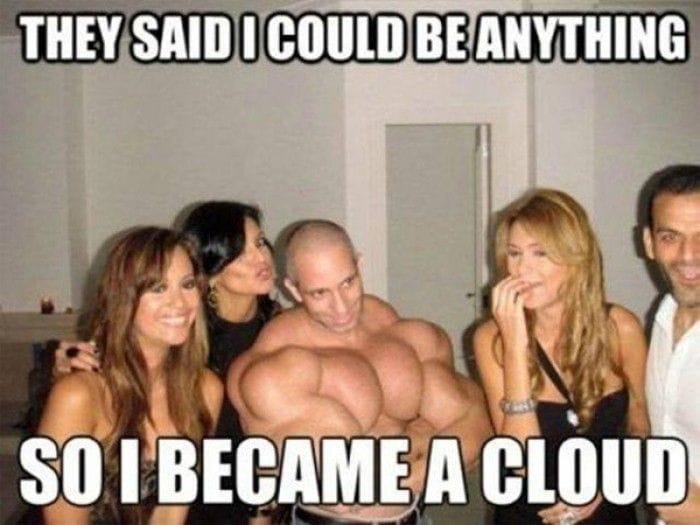
    The "They said I could be anything, so I became a cloud" meme, featuring a muscular gentleman surrounded by admirers.
    This isn’t the plan, but the meme is timeless so I made sure to include it.

    Back when I started this newsletter, I was using how many pull-ups I could(n’t) do as a success metric. I stopped updating progress because I was embarrassed the number wasn’t going up, which is what happens when you don’t, uh, work out. But I do now, and the numbers are in: I’m doing 20+ pull-ups in a given gym session — and that’s in between my other exercises. I’m pretty pleased with that. Pull-ups are hard. But it’s still early days. I have a specific and quite ambitious goal in mind for how much I’d like to be able to lift: the goal is to bench-press 100 kilos, and to be able to do a muscle-up, which is probably the most aptly-named callisthenic exercise in existence.

    No-one except Louise and my t-shirts has noticed that I’m going to the gym, but I’d like to think that’s not why I’m going. I read once that, one day, you pick up your child for the last time, and — as an older dad — I want to delay that day for as long as possible. If I keep tracking the way I am now, I’ll still be able to yeet my boy Leo well into adulthood, and that’s exactly how I want it.

    Hopefully telling you about it won’t stop it from happening.


    I originally titled this newsletter “Harder, Better, Faster, Shorter” not just to get the Daft Punk song in your head but because it was meant to be shorter than normal. That hasn’t worked out, but oh well. Substack lets you do surveys, so I’ll pop this one here – I want to find out what kind of newsletter frequency you’re actually after here.

    And, as usual, I look forward to chatting in the comments.


    1. Hilariously, Tim suggests 1 percent of your income as a decent amount to wager, which gives me a great idea for a business taking advantage of serial over-committers. ↩

    2. It’s almost always students. No-one else is at enough of a loose end to voluntarily do psych research. ↩

  • The Hand That Feeds

    The Hand That Feeds

    A short lunchtime post today. Let’s begin with a (gift) link to an Atlantic story revealing Substack’s Nazi problem. How bad is is it here? This bad:

    At least 16 of the newsletters that I reviewed have overt Nazi symbols, including the swastika and the sonnenrad, in their logos or in prominent graphics. Andkon’s Reich Press, for example, calls itself “a National Socialist newsletter”; its logo shows Nazi banners on Berlin’s Brandenburg Gate, and one recent post features a racist caricature of a Chinese person. A Substack called White-Papers, bearing the tagline “Your pro-White policy destination,” is one of several that openly promote the “Great Replacement” conspiracy theory that inspired deadly mass shootings at a Pittsburgh, Pennsylvania, synagogue; two Christchurch, New Zealand, mosques; an El Paso, Texas, Walmart; and a Buffalo, New York, supermarket. Other newsletters make prominent references to the “Jewish Question.” Several are run by nationally prominent white nationalists; at least four are run by organizers of the 2017 “Unite the Right” rally in Charlottesville, Virginia—including the rally’s most notorious organizer, Richard Spencer.

    The rest of the article is just as damning. I am only annoyed that I didn’t write about it myself; Nazi content on this website isn’t hard to find, and I could have reported on it much earlier. That said, I am glad that a mainstream publication is addressing the issue.

    It’s been known about for a long time, and Substack, to its enormous discredit, has done nothing about it. Instead, they’ve worked to explicitly elevate “alt-right” types like Richard Hanania, with this simpering puff piece and accompanying podcast by Substack cofounder Hamish McKenzie. When Huffington Post writer Christopher Mathias revealed Haniana’s past as an overt white supremacist writing under the pseudonym “Richard Hoste,” Substack’s silence was deafening. They did not retract or otherwise repudiate their article, or even really address the controversy. As the Atlantic article makes clear, Substack already has terms of use that ban “hate,” but they’re not enforcing them. Instead they’re striving to be edgy, sucking up to weirdo Silicon Valley accelerationists, and making cringeworthy ads:

    Please note this isn’t about encouraging “free speech,” a position I have a lot of sympathy for, because Substack aren’t genuine free speech maximalists. If they were, they’d allow all non-criminal speech, including explicitly protected and legal forms of free speech like pornography and other kinds of sex work. They don’t, and this makes them free speech hypocrites.

    The "are we the baddies?" meme bit from Mitchell and Webb

    With Substack’s Nazi problem now very much out in the open, the platform now has a choice: enforce their terms of use and evict the vile people who make a living (and make money for Substack) by peddling overt hate to huge audiences, or maintain their current course and become a Nazi bar. I suspect they’ll pick option B, which sucks. I have good friends who make their entire living from writing on Substack and the platform’s hypocritical, ideologically inconsistent free-speech-for-Nazis-but-not-for-boobies policy is putting writers in a terrible position. If they stay, it looks like they’re okay with being on a platform that doesn’t just permit but promotes hate. If they leave, they risk losing their livelihood.

    Clearly, organised opposition is what’s needed. If this site’s writers banded together and threatened to leave Substack en masse, the resulting revenue hit might make continued Nazi-coddling untenable. Writers are already organising:

    In my opinion, the choice is stark: if you’re a non-Nazi writer who objects to Substack making money from white supremacists (not to mention this site’s vast swathe of TERF writers and culture-war contrarians) you should make this extremely clear to the site founders, ideally in an organised, public way that doesn’t allow for individualised, targeted pushback. You could look to leave altogether, taking your subscribers and their revenue elsewhere: there are other subscription email providers that either have ideologically consistent free speech policies — allowing all legal speech, not carving out convenient exceptions for Nazis — or that don’t go out of their way to promote Nazis at all. Revolutionary stuff! Here are some alternatives:

    Buttondown

    Buttondown is not “free” in the way Substack is (Substack takes a big cut of your subscriptions) but they’re an inexpensive option for independent publishers. Also they seem like good sorts on social, without any pretence of “creating a new economic engine for culture.”1

    Here’s Buttondown’s Substack migration guide, including moving your paid subs.

    Ghost

    Ghost Pro is a very Substack-like experience for your newsletter and subscribers, with the option to self-host if you’re a tinkerer.

    Here’s Ghost’s Substack migration guide, including moving your paid subs.

    WordPress

    WordPress.com’s Newsletter product now offers a paid email subscription option, including the ability to connect your existing Stripe account for paid subs.

    There are other options out there too. For my part — as all my posts here and at The Cynic’s Guide To Self Improvement are free anyway — I will definitely be moving my newsletters to another platform if Substack doesn’t come up with a satisfactory response to their Nazi problem. It’s long overdue.


    1. Also, nerd alert, it *lets you write in Markdown.* God I love Markdown. Every internet writing system should let users use Markdown. ↩

  • Yeet your phone

    Yeet your phone

    A few weeks back, I noticed my iPhone screen-time averages were starting get a bit silly. Like a lot of smartphone users, my device is set up to passively scold me for how long I use it, and last week it informed me that my use time was down slightly to an average of just… three hours a day.

    This meant my average time the previous week was close to four hours a day.

    “I had my reasons!” I reasoned. There are lots of apps I use for work — Gmail, Slack, others. I’d written a time-consuming and fraught article on Christian Zionism for Webworm and I’d spent a lot of time popping in on the Substack app to check on the comments. And there was, uh, Instagram. Gotta check the ‘gram, right? How else would I know what my rapidly ageing millenial cohort were up to?

    But four hours seemed excessive.

    At the risk of pointing out the obvious, there are only 24 hours in a day, and 8 of them (if you’re lucky) you spend asleep, so four hours is… a lot. There’s lots of other things I want to be doing, not least of which is consistently updating my self-improvement newsletter.

    I started writing this article, and then I was taken with the sudden urge to Do The Maths.

    It was very depressing, and it went like this:


    Let’s assume I’ve spent three hours a day on a smartphone since I got my first one. It was more than 10 years ago, but we’ll be generous and allow for just one decade of smartphone use. What’s more, we’ll say that I only used it for three hours a day for six days a week. Inventing a kind of smartphone Sabbath should allow for any days I used it less than three hours.

    So. There are 52 weeks in a year. Multiply 52 by 6 and that gives us 312: how many days I use my phone in a given year.

    (Ironically, I am using my smartphone’s calculator app to do these calculations.)

    Multiply 312 by the 3 hours a day I use my phone and I get 936. Nine hundred and thirty six hours a year.

    Shit.

    Let’s multiply those 936 hours by 10 years and that gives us… 9,360 hours over the last decade. God.

    How many total days is that?

    Break out the division. 9360 hours divided by the 24 hours in a day will give us the total number of days.

    It’s 390.

    Three hundred and ninety days.

    Fifty-five weeks and four days.

    About one year and one month.

    It’s the equivalent of being on my phone continuously, day and night, without stopping, for more than a year.

    What?!

    I must have the maths wrong. I check it with my wife. She’s a primary school teacher, this kind of maths is her bread and butter.

    (At this point I really did go upstairs and check the preceding paragraphs with Louise.)

    Unfortunately, I am right.


    It’s not just me. And it’s not just you. Estimates of average daily smartphone use vary, but reputable studies put it at between 2 hours a day (at the low end) and almost 6 hours a day (at the high end.)

    What’s more, the only thing more popular than smartphones might be the desperate search to disconnect from the damn things. Scratch the surface and the articles are everywhere: “Device-addicted parents struggling to curb kid’s screen time,” worries an RNZ headline, with a buried lede that parents are struggling even more to curb their own screen time. Linked in the RNZ story is a piece by NYU professor John Haidt with the (contested) theory that “Social Media is a Major Cause of the Mental Illness Epidemic in Teen Girls.” Meanwhile, the Spinoff has a helpful power ranking of all the ways writer Madeleine Holden has tried to curb her own smartphone addiction, and advice columnist Hera Lindsey Bird has a …broad spectrum of suggestions:

    There are easy things you can do to limit how interesting your phone is. Mute all but essential notifications. Make everything grayscale. Kill every potential source of dopamine. You could get an alarm clock, or even better, a clock radio. You could charge your phone in another room. You could swap your phone for a fax machine. You could swap that fax machine for a water blaster, and comprehensively clean all your walkways.

    Take all these anecdotes of compulsive use, add users’ desperate desire to quit, and you’ve got something that looks a lot like an addiction. There are plenty of people who’ll tell you that this waddling, quacking bird is definitely a duck. If you’ve ever searched the topic you’ll be familiar with explanations like this one from Stanford professor Anna Lembke, who suggests our smartphones have turned us into “dopamine addicts.”

    “We can very quickly then get into this vicious cycle, where we’re not reaching for something to feel good, but rather to feel normal or to stop feeling bad.”

    Continuous over stimulation of the brain’s pleasure pathways worsens the situation, she says.

    “If I continue to bombard my brain’s reward pathway with these highly reinforcing drugs and behaviours, I eventually end up with so many Gremlins on the pain side of my balance, that not only do I need more and more to get the same effect, but when I’m not using, I’m in a dopamine deficit state, I’ve got a balance tilted to the side of pain.

    “I experience the universal symptoms of withdrawal from any addictive substance, anxiety, irritability, depression, insomnia, craving. And I will then seek out that drug not to feel pleasure, but just to stop feeling pain.”

    It seems clear that smartphones can be addictive, but there’s always the danger — as so many self-taught self-improvement influencers do — of biffing babies out with the dopamine bathwater. Thanks (ironically) to my unhealthy YouTube habit, I’m exposed almost constantly to people who pick up the notion of “dopamine fasting” and run off a cliff with it. To make some points that should be obvious: Smartphone use is not a closed loop, there are an infinity of things that make people happy or sad that predate smartphones by a few hundred thousand years, and you need dopamine to live. The list of extremely legitimate reasons to use smartphones is long. In many countries, the villages that we need to live and work and raise children are all but gone, and in place of spaces where we walked and talked together are a billion lonely boxes, each containing social creatures with a desperate need to reach out. If you can’t do physical, then digital will do. If you’re a new mum, nap-trapped by an infant, sending memes to your mates might be what’s keeping you sane. And if you are an activist or a journalist or a politician or an artist or one of any number of things, a huge part of your job takes place in online social spaces, and you need to Post.

    And for years, that’s what I’ve told myself: I’m an artist, and I write, and I need to be online. Reading an article or ten feels like virtous work, as does scrubbing through a tutorial on YouTube. What I watch is often deeply entwined with my identity. And it has to be said that screens are, in many ways, wonderful. During the pandemic, I could keep in touch with family and friends all over the world. My son knows his grandparents and cousins by sight; in ye olden 90s we would have made do with voice-only phone calls, photos and (if we were lucky) a videotape. Having all the world’s knowledge, a high-powered camera, and even a calculator (take that, maths teachers) with me at all times is a boon.

    Yet. These days, as I scroll, it’s accompanied with the feeling that I’ve been conned. Looking at the numbers, it’s clear: I’ve spent more than a year of my life on smartphones and the return on investment is terrible. You could excuse the sheer amount of time spent if there’d been something to show for it — a big social media presence, the ability to code, learning a language on Duolingo, a consistent output of pretty much anything creative. But I can’t make any of those claims. I know life is about much more than “productivity,” but even with that caveat my phone time is staggeringly unproductive. I post perhaps twice on Bluesky or Mastodon on a big day. Instagram is maybe once a week. Nearly all the time I spend on my phone (and, if I am being honest, my computer) is in passive consumption. Lurking. I don’t have many good memories of the half of my life I’ve spent on screens, or in fact any strong memories at all; it’s all one amorphous, algorithmic blob of memes and blogs and socials and takes.

    My first thought on doing all those calculations was: how am I even finding the time to use my phone this much? I’m busy. I have a demanding day job. I have a social life. I’m a dad to a toddler. I cook and clean and walk and go to the gym. There’s practically never a time when I am on my phone for more than 20 minutes at a stretch. I think I could count the times I’ve spent more than an hour in one session on one hand.

    But a bit of thought solves the not-mystery.

    It’s the in-between times. 5 minutes here. 15 minutes there. Opening the phone to a notification of a text from a friend only to open Insta to be reminded of a meme you want to send to another mate but only after watching a mildly interesting reel lifted from someone else’s Tik-Tok. It adds up quickly.

    It is, to age myself with a simile, like changing gears in a manual car. If I’m finishing a task (let’s say, the weekend morning dishes) and I need to do something quite different (let’s say, go to the gym) a nice smooth gear shift will have me picking up heavy things in no time. But add my phone to the mix — a quick reply to a mate, an email check to see if that package has shipped yet (hope, nope), scrolling to pick the right playlist or podcast, pausing to download an audiobook — and it’s like leaving your car to idle in between gears, eventually to slow down or stop. Suddenly it’s 25 minutes later and getting a full workout in before I need to take my son to his appointment is impossible. May as well not go!

    This sort of thing happens all the time.

    It seems frighteningly obvious that the life I want to live is being eaten by my smartphone screen.

    In fact, it’s so obvious that the only reason I can think of for not giving it due attention is because of how frightening it is.

    I felt like a character in a whodunit who’d always known who dun it but was too scared to admit it.

    And that’s just smartphones. Once you add TVs and computer screens to smartphone use, things get scary. Time spent on screens goes from a worryingly significant fraction of life to the overwhelming majority of it, to the point where the words “HE LOOKED AT SCREENS” would make a cruelly accurate epitaph.

    My brain’s so cooked by it all the only way I can visualise it is in meme form:

    Here’s the thing: for all the advice richocheting around the Internet on how to curb your Internet-adjacent addictions, there’s probably only one thing for it.

    Cal Newport, the irritatingly fresh-faced author of a couple of self-help books I’m sure I’ll get around to reviewing one day, puts it succinctly. (You don’t have to watch the whole video. This clip should start it right at the relevant bit.)

    Yes, that’s right. The answer was right there in the Book of Mormon1 all along.

    Just… turn it off.

    Book of Mormon. Turn it Off | Book of mormon musical, Book ...

    I took the medicine. Just before I started writing this article, I deleted all the social media apps from my phone. Twitter? X’d it. Mastodon? Mastadon’t. Bluesky? I blew it right off. Reddit? More like didn’t read it. Instagram? Instagone.

    I wish I could say that I felt better instantly but it’s been several days now and I’ve felt twitchy and tired and I keep picking up my phone and putting it down for no reason at all.

    If smartphone use is an addiction, this seems about right for withdrawal symptoms. I’ll say this: it does feel startlingly similar to when I quit smoking.

    I don’t expect my productivity to suddenly peak. I’m an accomplished procrastinator; life will find a way.

    But if I can get those lost slices of life back — those moments of necessary boredom, of smoother gear-shifts in between tasks, of seeing my son playing instead of gazing into the abyss of my phone and having it algorithmically gaze back — then it’ll be worth it.

    I’ll let you know how I go. If you decide to do something similar, I’d love to hear how you manage.

    EDIT: Annoyingly, I just found out I accidentally sent this newsletter out with comments for paid subs only, which is the Substack default, and wasn’t my intention. I’ve fixed it now, so comment away!

    Also I got this notification this morning. It’s still too much, but it’s a big improvement. The system works!(?)


    For entertainment purposes, if by “entertainment” you mean “being crushingly depressed,” I have made a spreadsheet you can use to calculate your own abyss-gazing tendency: how many years of your life it’s taken to date, and how many it will remove from your future. Just put your age in years in cell B1, how many years you’ve had your smartphone in cell B2, and your average daily hours of smartphone use in cell B3. Enjoy!

    Yeet Your Phone: The Spreadsheet.


    1. The stage musical, not the actual book. ↩

  • The Dark Present

    The Dark Present

    Hi! I hope you enjoyed the sunshine in the Brighter Future. Unfortunately, today’s newsletter is a return to the Dark Present, with a timely reminder that everything is danged1 and it’s all economics’ fault.

    Well, that’s not 100 percent correct: it’s lots of people’s fault, especially the governments who’ve refused to reign in the mad paper-clip machine of capitalism and have set civilisation on a course straight for the heart of the Sun, but neoliberal, orthodox economists deserve an outsize share of the blame for chaining the rest of us to the mast so all we can do is watch. And William Nordhaus is one of the crew — standing on the shoulders of giants like Milton Friedman and Friedrich Hayek — who’s done the most incalculable damage. When our kids ask us “Who killed the world?” we’ll be able to confidently answer “This guy.” The Intercept has the horrible details. Briefly paraphrased, the scoop is that Nordhaus’ theories that calculate the economic impacts of climate change are bollocks.

    Nordhaus’s models tell us that at a temperature rise somewhere between 2.7 and 3.5 degrees Celsius, the global economy reaches “optimal” adaptation. What’s optimal in this scenario is that fossil fuels can continue to be burned late into the 21st century, powering economic growth, jobs, and innovation. Humanity, asserts Nordhaus, can adapt to such warming with modest infrastructure investments, gradual social change, and, in wealthy developed countries, little sacrifice. All the while, the world economy expands with the spewing of more carbon.

    His models, it turns out, are fatally flawed, and a growing number of Nordhaus’s colleagues are repudiating his work.

    chuckles I'm in danger meme template HD | Ralph In Danger | Ralph wiggum,  Memes, Meme template

    Yes, it turns out that Nordhaus’ work is pure copium, so attractive and addictive that it’s been mainlined by everyone from corporates to governments to the IPCC.

    Johan Rockström, director of the Potsdam Institute for Climate Impact Research in Germany and a leading researcher on climate tipping points and “safe boundaries” for humanity, projects that in a 4 C warmer world, “it’s difficult to see how we could accommodate a billion people or even half of that.” Global population today stands at 7.6 billion, with 80 million people added every year.

    By contrast, when Nordhaus looked at the effects of 6 C warming, he did not forecast horror. Instead, we should expect “damages” of between 8.5 percent and 12.5 percent of world GDP over the course of the 21st century.

    He’d have gotten away with it too, if it wasn’t for those darn meddling laws of thermodynamics.

    Start with your typical textbook for the dismal science — say, the definitive one by Paul Samuelson, co-written with Nordhaus, titled “Economics.” The book is considered “the standard-bearer” of “modern economics principles.” You’ll find in its pages a (…) simple, imperturbable closed system that’s also ludicrous, fantastical, a fairy tale. In the circular flow diagram of standard economics, nothing enters from the outside to keep it flowing, and nothing exits as a result of the flow. There are no resource inputs from the environment: no oil, coal, or natural gas, no minerals and metals, no water, soil, or food. There are no outputs into the ecosphere: no garbage, no pollution, no greenhouse gasses. That’s because in the circular flow diagram, there is no ecosphere, no environment. The economy is seen as a self-renewing, perpetual-motion merry-go-round set in a vacuum.

    So how does it all work? Nordhaus’ theories are, of course, predicated on the fairy-tale of endless economic growth. Pry the lid off the voodoo equations of orthodox economics and you’ll find the same basic fallacy over and over again: line goes up.

    In DICE, the effect of a warmed climate is measured solely as a percentage loss (or gain) in GDP. Growth of GDP is assumed to be “exogenously determined,” in the language of economics theory, meaning it will persist at a set rate over time regardless of climate shocks.

    Like other orthodox economic fallacies such as the Phillips Curve — an illustration of the idea that having too much employment causes inflation, so having unemployment must necessarily un-cause it — Nordhaus’ DICE model is based on a fundamental misuse of mathematics:

    The second of Nordhaus’s errors is the use of reductionist mathematical formulas. He employs something called a quadratic to calculate the relationship between rising temperatures and economic outcomes.

    Economists are always doing this. They love nothing more than finding a concept that’s hideously complex and intrinsically non-linear and drawing crayon-like curves all over it. But wait, it gets much, much stupider.

    The third of Nordhaus’s errors is related to similarly simplistic formulas. Nordhaus calculates GDP of a particular location as fundamentally related to the temperature of that place.

    What — and I really must stress this — the dang. How does economics manage to elevate such abject, obvious idiocy to the pinnacle of the profession? The assertion is self-evidently untrue. GDP is not a function of your danging latitude. Nor is it a function of Nordhous’ next colossal mind-fart:

    The fourth fatal error Nordhaus makes is the most farcical. In a 1991 paper that became a touchstone for all his later work, he assumed that, because 87 percent of GDP occurs in what he called “carefully controlled environments” — otherwise known as “indoors” — it will not be affected by climate.

    It really has to be said again and again: dang economics.

    Lest we forget, it’s also orthodox, neoliberal economics that has gifted us the currently-in-vogue method of dealing with climate change: carbon trading and emissions offsets. Let’s be clear: setting a price on carbon pollution is a good thing. But economists have, of course, poisoned the well of carbon pricing with carbon offsets: the idea that we can make up for burning carbon here by not burning carbon there, and that we can turn not-burning into licences to burn carbon. Factor in the idea of the world ploughing its valuable energy resources into mostly hypothetical technology to suck carbon out of the air and turn it into worthless dry ice and boom, you’ve got a plan to save civilisation — one that, typically for economics, makes no danging sense. Cory Doctorow has the goods:

    [Carbon offsets allow] companies to make money by promising not to emit carbon that they would otherwise emit. The idea here is that creating a new asset class will unleash the incredible creativity of markets by harnessing the greed of elite sociopaths to the project of decarbonization, rather than to the prudence of democratically accountable lawmakers.

    Carbon offsets have not worked: they have been plagued by absolutely foreseeable problems that have not lessened, despite repeated attempts to mitigate them.

    For a break from all this, let’s look at journalist David Williams’ deep dive into what NZ’s local enemies of climate action have been up to lately. Ah, of course. They’ve been working to elect climate change deniers, minimisers, and delayers, in the form of the Act and National parties:

    In the Taxpayers’ Union’s first press statement, in 2013, its founders described it as “a politically independent grassroots campaign to lower the tax burden on New Zealanders and reduce wasteful government spending”.

    The independence claim has been repeatedly knocked.

    In Dirty Politics, Hager wrote the Taxpayers’ Union “operates, in effect, as an arm’s-length ally of the National Party” and called it a “political tool”.

    The following year, political scientist Bryce Edwards described the Taxpayers’ Union to the NZ Herald as “the Act Party in drag”.

    A huge share of the blame for the Taxpayer’s Union’s success can be laid at the feet of news media, who essentially let political actors like the TPU and the Act party do their jobs for them. These groups function as press-release factories, churning out readymade news for conflict-hungry media, who are only too happy to both-sides climate-denying hysteria-bait about (for example) cycleways if it leads to them getting a few more clicks. They also make themselves permanently available, always ready to feed a juicy, conflict-loaded, nuance-free soundbite to the media maw. Witness the Spinoff’s live updates editor telling on himself as he complains that David Seymour won’t pick up the phone anymore:

    During the Judith Collins years, he twisted this level of availability into becoming a de facto opposition leader, commonly leading coverage where the National Party leader would traditionally be found. If you couldn’t get a comment out of National, you’d get on the blower to Seymour and he’d give two or three well-communicated soundbites on just about anything.

    Most journalists would ring him directly, or text him and expect a return phone call within minutes. On one occasion, he called me via a bluetooth bike helmet and I did the interview while he was cycling around his local electorate.

    “Well-communicated soundbites!” I’m so sick of this stuff from journos. When will they learn that their job is not to hand out praise to politicians based on well they spin the issue du jour? That it’s not to give space to people — especially not powerful people — just because they’ll pick up the danging phone? Of course David Seymour’s not answering your calls: he’s in negotiations for his real job — attacking indigenous rights and sabotaging climate change action. What’s left of the (broadly) reputable Fourth Estate needs to figure out where it stands on climate change, ideally yesterday, and to stop platforming climate change deniers, delayers and minimisers like David Seymour and the Taxpayers Union without conspicuous disclaimers about what their policies and actions are and mean.

    While I’m on the subject of lazy media, here’s another ghastly habit that can get in the bin and die: the uncritical repetition of political and economic myths. From yesterday’s Spinoff Bulletin newsletter, we get this:

    By now, we all know the orthodox drumbeats: when employment levels are high, wages rise faster. People have more money to spend, so prices go up and so does inflation. When unemployment is high, the lack of money to spend means that inflation goes down. It is our old mate, the Phillips curve, conceived by New Zealander Bill Phillips. A consensus of bank economists ( paywalled, and is that the collective noun or just an accidentally clever allusion to it by Liam Dann?) is picking that the unemployment rate will have risen. Most are pinning that prediction on high levels of migration.

    It’s nice that we seem to be gradually approaching the point where people might finally start saying the quiet part loud: unemployment is largely a political and fiscal choice, designed to keep wages (and inflation) suitably low; but what’s not being said is that simplistic economic concepts like the Phillips Curve are at best contested and at worst bunk. Even orthodox economists have had enough of the Phillips Curve: witness the ultra-neoliberal Cato Institute call it a “broken theory” and “a poor tool for policymaking.” So here’s another reminder, because you can never have enough: the broken idea behind raising interest rates is to make people lose their jobs and/or houses so inflation might come down.

    The fact that inflation might happen not just because people have jobs, and could just as easily be attributed to supply constraints and massive corporate profiteering doesn’t seem to matter, least of all to media who are happy to keep repeating economic myths and making space for climate change creators.

    On that note, and in good news for no-one but economists, there are signs that the Reserve Bank might finally be succeeding in engineering its longed-for recession:

    The below, earlier issue of Hickey’s newsletter is well worth reading, not least because he shares some gobsmacking tidbits that should be being screamed from the rooftops by the rest of the media — like the fact that at current rates of growth (which successive Governments have both encouraged and done nothing to prepare for) NZ’s population will exceed 20 million by 2100.

    Wednesday’s Chorus: An impossible trinity
    Listen now (31 mins) | TL;DR: The key news in Aotearoa’s political economy today includes: National appears set to push councils to move their water assets off their balance sheets in a very similar way to Labour’s Three Waters plan, just without the co-governance and as much compulsion, but still with the flawed idea that somehow off-balance-sheet borrowing is actually better for taxpayers and ratepayers in the long run than facing up to the fact that higher taxes, charges and public debt are needed to fund fast population growth;

    And then there’s this humdinger.

    A Treasury analysis of the potential costs of the Crown having to buy emissions credits to meet its Paris agreement commitments was released in September and shows the cost to taxpayers could blow out to $25.948 billion by 2030, if as expected with current policies, there is a shortfall.

    This is not included in the Crown Accounts as a contingent liability. If it was, a Government would be obliged to try to reduce it, or have to explain to taxpayers why they’re spending more on emissions credits overseas than it spends on health in a year.

    The other option would be to renege on the Paris agreement, which ACT has advocated, and then see New Zealand’s FTA with Europe cancelled arbitrarily.

    That’s where our “but David Seymour has perfectly-crafted soundbites and always picks up the phone!” attitude gets us: the neoliberal party looks to cost us billions of dollars in worthless “offsets” that we will be forced to buy for breaching our Paris commitments by not following the ETS, a climate policy advocated for and invented by neoliberals. Of course, none of that includes the staggering costs of not sufficiently adapting to or mitigating climate change, which are going to be much, much, much more. I’d say that we should just burn it all down, but that’s happening anyway. Happy days.


    1. After getting a tip that my swearing was making my work hard to share I decided to change all incidences of the word that autocorrects to “duck” to “dang” or something similar. It’s perhaps a bit silly — I think it is OK to be angry about bad things, and that swearing is useful as punctuation among much else — but there’s no doubt that replacing swears makes the article much funnier. The original blue-tongued article will live on, in subscriber inboxes, and you can always mentally substitute “dang” for any other word you like. ↩